

Used Car Inventory Acquisition: How Dealers Source Retail Units Without Overpaying at Auction
Every used car manager knows the feeling: the lot needs 20 more front-line units, the auction lanes are full of other dealers bidding on the same cars, and every unit you win arrives with buy fees, transport and reconditioning surprises. Used car inventory acquisition is the discipline of fixing that problem on purpose. It means deciding where your next 100 units will come from, what each channel costs per unit, and how to pull more of them from your own market instead of from the lane.
This guide is written for dealer principals, GMs and used car managers. It covers the main vehicle acquisition channels, how to compare them on true cost per unit, how to appraise to buy instead of appraising to steal, and how a buyback or trade-in acquisition event can bring local owners and their vehicles to your store in a few days.
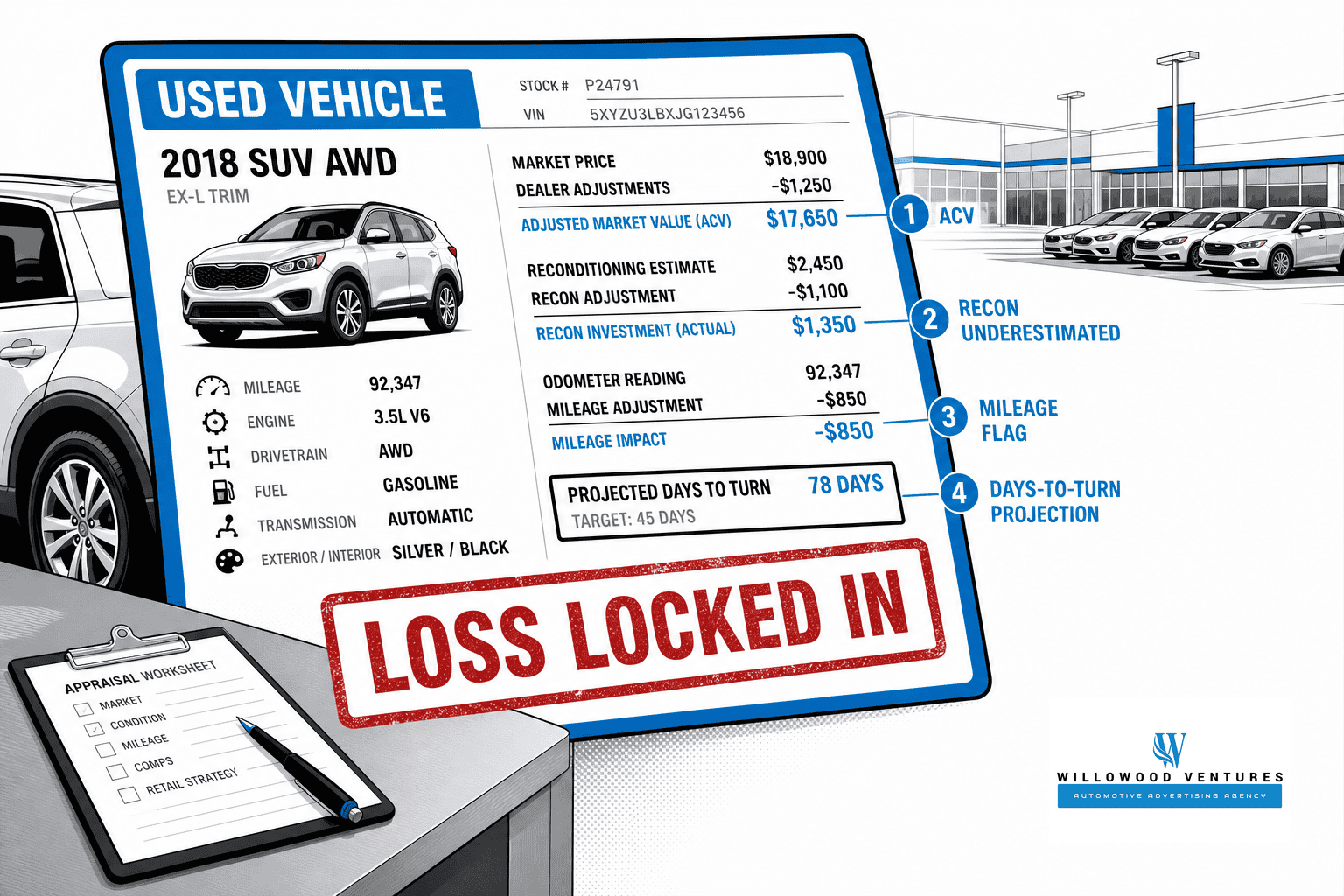
What used car inventory acquisition means for a dealership
Acquisition is everything that happens before a unit is on your lot: finding the vehicle, valuing it, buying it and getting it front-line ready. Most stores treat it as the used car manager’s job and measure it loosely. The stores that turn used inventory fastest treat it like a sales process with its own funnel, its own budget and its own weekly report.
The reason is simple. In the used car department, you make most of your money when you buy the car. A unit bought right can be priced to the market, turned in under 30 days and still hold gross. A unit bought wrong sits, ages, gets wholesaled and eats the margin from three good deals. That is why vehicle acquisition belongs on the GM’s dashboard next to leads and appointments.
The six vehicle acquisition channels and what each one costs
Every store sources from some mix of the same channels. The difference is the mix and how hard each one is worked.
- Trade-ins on retail deals. The best units most stores get. Known history, local, no transport, and a replacement sale attached. The cost is the marketing it takes to bring in the trade.
- Service drive acquisition. Owners already in your shop, often with equity and a repair estimate they do not want to pay. Low cost per unit when someone actually works the drive every day.
- Database and equity mining. Past sales and finance customers whose payment, term or equity position makes a trade attractive now. Low cost, high quality, and usually under-worked.
- Buying from the public. “We buy cars” offers, online appraisal tools and buyback events that invite owners who are not shopping yet. Cost depends on how well the offer and follow-up are run.
- Auction and digital wholesale. Reliable volume, but you pay buy fees, transport and the price set by a lane full of competitors. Fine for specific gaps, expensive as a primary source.
- Dealer trades and wholesale partners. Useful for specific units, rarely a scalable source of front-line inventory.
Most used car managers can tell you roughly what an auction unit costs all-in. Few can tell you the cost per acquired unit from the service drive or from a buyback campaign. Building that number is the first step to shifting the mix.
Compare channels on cost per retail-ready unit
To compare channels honestly, use the same formula for each one:
- Acquisition price versus the wholesale value of the unit on the day you bought it.
- Fees and transport: buy fees, auction fees, shipping and any arbitration cost.
- Reconditioning: actual recon dollars, not the estimate.
- Marketing cost per unit: the spend on that channel divided by units acquired from it.
- Days to front line and days to sale: every day of holding cost and floorplan counts.
- Gross on the retail sale plus any gross on the replacement vehicle sold to the same owner.
When stores run this math, local acquisition usually wins. An owner who sells you a car often buys one in the same visit. An auction unit never brings a customer with it.
Appraise to buy, not to steal
A local acquisition program only works if the appraisal process buys cars. A disciplined appraisal starts with the vehicle: walk it, drive it, check history and note reconditioning needs. Then pull wholesale guides such as the Manheim Market Report (MMR) and retail comps inside your selling radius, and decide the exit before you make the number. Is this a front-line retail unit, a value unit or a wholesale unit?
From there, the offer should be one your desk can defend. Show the owner the market data, explain the difference between wholesale and retail in plain terms, and leave room to close. Lowballing every owner may protect gross on paper, but it kills the program. The owner walks, tells friends, and your next campaign pays for that reputation.
Write the appraisal standards down. Who appraises, how fast the number gets delivered, who can bump it and by how much, and how a declined offer gets followed up. Speed matters. An owner who waits 45 minutes for a number is an owner who leaves.
Turn your market into an acquisition channel
The units you want most are already in your market, parked in driveways and in your own service lane. The job is to give those owners a reason to come in now. That is what a buyback or trade-in acquisition event does. It packages a clear offer, “we want to buy your vehicle,” into a short window, staffs the desk with appraisers and works a replacement deal for every owner who wants one.
Social advertising is the fastest way to reach those owners. Facebook and Instagram ads can target owners in your area by vehicle, life stage and in-market signals, then send every response into a conversation instead of a dead web form. When every reply is answered fast and turned into an appraisal appointment, a store can acquire a meaningful number of retail units in a few days.
Two Willowood results show what that looks like. South Charlotte Chevrolet booked 152 confirmed appointments in 3 days and acquired 47 retail trade-ins. O’Fallon Buick GMC acquired 49 retail trade-ins in one event. Across Willowood events, the average trade-in rate is 79%.
Build a weekly acquisition report
What gets measured gets bought. A simple weekly report keeps acquisition on the GM’s radar:
- Units acquired by channel: trades, service drive, database, public buys, auction, dealer trades.
- Appraisals completed and look-to-book ratio by appraiser.
- Average cost to front line and average days to front line by channel.
- Marketing spend on acquisition and cost per acquired unit.
- Replacement sales made to owners who sold you a car.
- Aged units over 45 and 60 days, and which channel they came from.
Review it with the used car manager every week. When a channel is cheap and producing, add fuel. When a channel keeps producing aged units, change how you buy from it.
How Willowood Ventures helps dealers acquire more used inventory
Willowood Ventures runs buyback sales events and Facebook Sales Events for 600+ dealer partners and manages $4 million per month in social advertising. Each event uses 300+ targeting selects for in-market owners and 10 to 20 ad creatives per event with daily A/B testing. Our 24/7/365 US-based bilingual BDC answers every response with a 98.6% lead response rate and an average response time under 3 minutes, then books appraisal appointments on your calendar.
Events can launch within 24 hours, you keep all lead and appointment data, and you get a matchback report after the event. Dealers see approximately 800% average ROI and 90% of them rebook. For the planning side, see our guides on trade-in marketing and automotive equity mining and dealer buyback programs, and our aged inventory playbook.
Ready to source more retail units from your own market? Book a strategy call with Willowood Ventures.
Frequently asked questions
What is used car inventory acquisition?
Used car inventory acquisition is the process a dealership uses to find, value, buy and recondition the used vehicles it sells. It covers trade-ins, service drive buys, database and equity mining, buying from the public, auctions and dealer trades.
What is the cheapest way for a dealer to acquire used cars?
For most stores, local sources cost the least per retail-ready unit: trade-ins, the service drive and past customers found through equity mining. They avoid auction fees and transport, and the owner often buys a replacement vehicle in the same visit.
How should a dealer compare acquisition channels?
Compare each channel on cost per retail-ready unit: acquisition price against wholesale value, fees and transport, actual reconditioning, marketing cost per unit, days to front line and the gross earned on the retail sale and any replacement sale.
Where does MMR fit in vehicle acquisition?
The Manheim Market Report (MMR) is a wholesale valuation guide. Use it as one input after inspecting and driving the vehicle, then adjust for condition, reconditioning, local retail comps and your planned retail or wholesale exit.
How can a buyback event help a dealership acquire inventory?
A buyback event invites local owners to have their vehicle appraised during a set window, with a ready desk and a replacement deal for owners who want one. Willowood events average a 79% trade-in rate, and O’Fallon Buick GMC acquired 49 retail trade-ins in one event.

These tips really streamlined our processes; highly recommend!
We implemented several tips and saw an immediate increase in customer satisfaction and sales.