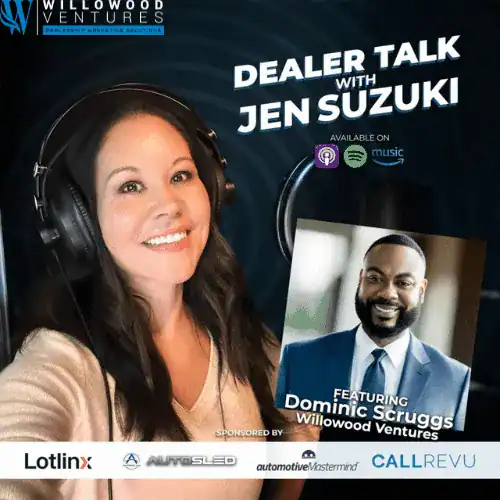
Willowood Ventures founder Dominic Scruggs sat down with Jen Suzuki on the LotLinx stage at NADA 2024 and held nothing back. Twenty-plus years running dealerships at the GM level will give you opinions, and Dominic had plenty. Here’s what came out of that conversation and why it still matters for your store.
Straight Talk from the LotLinx Stage at NADA 2024
Jen Suzuki doesn’t let guests off easy, and Dominic Scruggs didn’t need her to. As the founder and CEO of Willowood Ventures, Dominic spent over 20 years as a general manager before launching what is now recognized as a Meta Certified Business Partner. The NADA 2024 interview covered machine learning, used car acquisition, service-to-sales conversion, and why most dealerships leave money sitting in their own driveways every single day.
The conversation was candid, specific, and zero percent fluffy. That’s the only way to have it.
Machine Learning Is Not Optional Anymore
Dominic opened with a number that got attention: a 241% increase in sales within a single year, achieved by applying machine learning to automotive marketing. That result was covered by Automotive News. The point wasn’t to brag. The point was that the technology exists, it works, and dealers who treat it like a future problem are already behind.
Machine learning lets you stop guessing which cars to stock, which buyers to target, and which messages to send. It reads the market faster than any human can, then adjusts in real time. Dealerships that embrace this approach gain a structural advantage over competitors still relying on gut instinct and third-party lead lists.
Used Car Acquisition: Buy Clean, Price Right, Move Fast
Dominic was blunt on this one. The cleanest cars at the lowest prices win. That’s not a radical idea, but most dealers execute it poorly because they separate acquisition from reconditioning and pricing into three different conversations that never quite sync up.
His fix: loop the service department in from the start. Service advisors know exactly what’s wrong with a vehicle before the used car manager does. They see the history, flag the hidden problems, and can tell you in fifteen minutes whether a trade is worth pursuing at the number on the table. Ignoring that knowledge is expensive. Using it keeps your acquisition cost down and your reconditioning timeline tight.
Target the cars your market actually wants. Pull your own customer service appointment data and you’ll see patterns. Certain makes, certain trims, certain mileage bands show up over and over. Those are the vehicles your existing customers already drive and already trust. Stock more of them. You’re not guessing anymore, you’re filling real demand.
The Service Drive Is Your Cheapest Lead Source
This is where most dealers leave the most money. A customer sitting in your service drive is already on your property, already in a relationship with your store, and often already thinking about their next vehicle. A well-run service-to-sales program converts those moments into deals without the cost of a conquest lead.
Dominic made the case clearly: a service-to-sales program is not a nice-to-have. It’s essential for keeping used car acquisition costs manageable and keeping customers inside your ecosystem instead of walking into a competitor’s showroom six months later. The familiarity factor is real. People buy from dealers they trust, and a customer who has been servicing with you for three years already trusts you. Treat that like the asset it is.
At Willowood Ventures, we’ve built programs around exactly this model. Our BDC operates 24/7, US-based agents only, specifically so that when a service customer is ready to talk, someone picks up and moves the conversation forward. No voicemail black holes. No next-day callbacks on a hot lead.
Stagnant Inventory Is a Pricing and Visibility Problem
Every dealer has had a unit sit. Sometimes it sits because it’s priced wrong. Sometimes it’s priced right but positioned wrong in the listing. Dominic addressed both.
If a car isn’t moving, stop waiting for the market to come to it. Audit the listing description. Generic copy kills deals. A 2021 pickup with a spray-in bedliner, tow package, and one previous owner who drove it to a job site and back has a story. Tell that story. Buyers doing research online respond to specifics because specifics build confidence. “Well-maintained” means nothing. “Dealer-serviced at every interval, clean Carfax, non-smoker” means something.
Market positioning matters just as much as price. Know where your unit sits relative to the competition within a 50-mile radius. If you’re priced at market but your listing reads like everyone else’s, you’re invisible. Differentiate the description, add better photos, and give the buyer a reason to call your store instead of the next one.
Standing Out in Third-Party Listings
Third-party sites like CarGurus and AutoTrader show your inventory next to dozens of similar vehicles. If your listing looks the same as the others, you’re competing purely on price and losing margin you didn’t have to lose.
Dominic’s approach: treat every listing like a sales pitch, not a data dump. Lead with the features that match what your market actually searches for. Put the unique selling points in the first two lines because most buyers never scroll further than that. This is not complicated, but it requires discipline and consistency across your entire used inventory.
What Willowood Ventures Does with These Strategies
Willowood Ventures was built to operationalize exactly what Dominic described on that NADA stage. We’ve served 600+ dealerships and managed over $4 million per month in social advertising managed, and the numbers back up the approach. Real results from real stores: 64 sold for $294,821 at Little Rock VW, 89 sold for $421,593 at Salt Lake City GMC, 83 sold for $398,762 at Oklahoma City CDJR, and 72 sold for $345,688 at Torrance Chevrolet. Those aren’t projections. Those are closed deals.
Our programs start at Demo-Call Pricing and are backed by our Meta Certified Partnership. We bring the targeting, the creative, the BDC follow-up, and the accountability. You bring the inventory and the closing team.
Key Takeaways from the NADA 2024 Interview
Machine learning drives real results. A 241% sales increase in one year is not an accident.
Buy clean used cars at the right number. Use your service department to validate every acquisition.
Stock what your market already wants. Your service appointment history tells you exactly what that is.
Work your service drive. It’s your lowest-cost lead source and your best retention tool.
Fix stagnant inventory fast. Address pricing and listing quality at the same time, not sequentially.
Write listings that sell. Specifics outperform generic copy every time.
Watch the full conversation below, then call Willowood Ventures at 843-310-4108 if you want to talk about putting any of this to work at your store. We work with dealerships across the country and we know what moves the needle.
Make Willowood Ventures a preferred source on Google
One tap tells Google you want our dealership marketing coverage surfaced first. You will see Willowood Ventures more often in Top Stories, AI Overviews, and AI Mode when you search anything about selling more cars. It is free, it takes a second, and it brings you right back to this page.
Everything dealerships ask us about dealership sales strategy.
What is dealership sales strategy and why is it important for car dealerships? +
A dealership sales strategy is the structured plan a store uses to acquire inventory, convert leads, retain customers, and measure results. Without one, you’re running on habit instead of data, and habit rarely scales.
The difference between a store doing 80 units a month and one doing 130 is almost never the market. It’s process. Dealerships that define clear acquisition targets, run disciplined service-to-sales programs, and back their BDC with real follow-up protocols consistently outperform stores that wing it.
Willowood Ventures has worked with 600+ dealerships and the pattern is consistent: stores that commit to a documented strategy, execute it with trained people, and measure the right numbers grow faster and hold more gross. A dealership sales strategy isn’t overhead. It’s your competitive edge.
How do specific methods related to dealership sales strategy benefit dealerships? +
Specific methods, like machine learning-driven audience targeting, service-to-sales conversion programs, and VIN-level listing optimization, benefit dealerships by turning guesswork into repeatable systems.
Machine learning identifies which buyers are in-market before they submit a lead. Service-to-sales programs capture customers already on your property. Optimized listings reduce days to sale by giving online shoppers a reason to choose your unit over a competitor’s identical trim at the same price point.
Each method attacks a different leak in the sales funnel. When you plug them together, the compounding effect is significant. Dominic Scruggs achieved a 241% increase in sales within a year using this combined approach, and Willowood Ventures replicates that framework across client stores every month. Results vary by market, but the methodology is proven.
What are the key components of a successful dealership sales strategy? +
Five components show up in every high-performing store we work with. First, disciplined used car acquisition tied to real market demand, not just what came in on trade. Second, a service-to-sales program that converts your existing customer base into repeat buyers at a fraction of conquest lead cost.
Third, targeted digital advertising that reaches in-market buyers with the right creative at the right moment. Fourth, a BDC operation that follows up fast and follows up consistently. Willowood Ventures runs a 24/7 US-based BDC because leads go cold in hours, not days.
Fifth, accountability through metrics. Set rate, show rate, and closing rate need to be tracked every week. Our benchmark targets are a 35% set rate, 65% show rate, and 15% overall closing rate. If your numbers are below those marks, something specific is broken and it can be fixed.
How long does it take to see results from dealership sales strategy? +
Honest answer: some results show up in weeks, others take a full quarter to measure correctly. A targeted ad campaign driving appointment volume can show lift within the first 30 days. Service-to-sales programs typically need 60 to 90 days to build consistent workflow and get advisors comfortable with the handoff process.
Used car acquisition improvements take a bit longer because you’re changing purchasing habits and reconditioning timelines. But the discipline compounds. A store that commits to cleaner cars at tighter prices and shorter recon cycles sees the difference in their aged inventory report within 90 days.
The dealerships that see results fastest are the ones that start with a clear baseline. Know your current set rate, show rate, and closing rate before you change anything, so you can measure what actually moved the needle.
What kind of ROI can dealerships expect from professional dealership sales strategy? +
Willowood Ventures clients average approximately 800% average return on ad spend across our programs. That number reflects real closed deals tracked against program cost, not impressions or click estimates.
Look at actual store results: Little Rock VW closed 64 units for $294,821 in gross. Salt Lake City GMC closed 89 units for $421,593. Oklahoma City CDJR closed 83 units for $398,762. Torrance Chevrolet closed 72 units for $345,688. Those numbers represent gross revenue generated directly from our programs.
ROI will vary based on your market size, inventory mix, and how aggressively your team executes follow-up. But the framework is built to deliver. Our packages start with demo-call pricing, and the math on a single incremental sale in most markets makes that a straightforward decision. The stores that stay with us long-term do so because the return is consistent, not because the pitch was good.
How does dealership sales strategy differ from traditional dealership methods? +
Traditional dealership methods rely heavily on floor traffic, third-party lead purchases, and broad advertising with minimal targeting. The assumption is volume: run enough ads and enough people show up. That model worked when competition was limited to stores within a few miles.
A modern dealership sales strategy flips the model. Instead of broadcasting to everyone, it identifies the specific buyers most likely to purchase your specific inventory right now. Machine learning, customer data, and market demand signals replace demographic guesswork.
The other major difference is retention focus. Traditional methods treat every sale as a standalone transaction. A real strategy keeps the customer in your ecosystem through service relationships, targeted follow-up, and timing-based outreach. The 90% client rebook rate Willowood Ventures sees across its programs is the direct result of treating retention as a strategy, not an afterthought.
What role does BDC follow-up or audience targeting play in dealership sales strategy success? +
BDC follow-up and audience targeting are not support functions. They are the engine. You can have the best inventory and the right pricing and still lose deals because nobody followed up fast enough or the initial contact felt like a form letter.
Willowood Ventures operates a 24/7 US-based BDC because the window to reach an interested buyer is short. Speed matters. A lead that gets a personal call within five minutes of submitting converts at a dramatically higher rate than one that waits two hours for an automated email.
Audience targeting determines who sees your ads in the first place. Our Meta Certified Partnership lets us build and deploy audiences that target in-market buyers, conquest customers, and your existing database with precision. When targeting is tight and BDC response is fast, the metrics follow. Our clients consistently hit a 72% appointment show rate, which tells you the quality of the conversations happening before the appointment is even set.
How important is timing for launching dealership sales strategy? +
Timing matters, but waiting for the perfect moment is a way of not starting. The dealers who benefit most from a structured sales strategy are often the ones who committed during a slow month because they needed results, not the ones who waited for conditions to be ideal.
That said, a few timing factors are real. Launching a service-to-sales program heading into a high-traffic service season, like spring or pre-winter, gives you more customer interactions to convert. Launching a targeted used car campaign when your inventory is fresh and well-photographed outperforms a launch with a lot full of aged units.
The honest advice: don’t let timing become an excuse. Start with your current inventory, your current customer database, and your current team. Refine as you go. The stores that see the strongest results commit early and adjust based on data, not intuition.
What makes dealership sales strategy more effective than alternative methods? +
The biggest advantage of a disciplined dealership sales strategy over alternative methods is accountability. Broad brand advertising, generic third-party leads, and blanket email blasts all share the same flaw: they’re hard to measure at the unit level. You spend money and hope it worked.
A structured strategy ties every dollar to a measurable outcome. Which ads drove appointments. Which appointments showed. Which shows closed. At Willowood Ventures, we track set rate, show rate, and closing rate for every program because those three numbers tell you exactly where the process is working and where it’s breaking down.
The other advantage is specificity. Generic methods treat all buyers the same. A real strategy segments your audience, personalizes the message, and meets buyers at the right point in their decision process. That’s why machine learning matters. It reads patterns at a scale no human team can match and adjusts targeting in real time to stay in front of the right people.
Why should dealerships choose Willowood Ventures for their dealership sales strategy? +
Willowood Ventures is the premier choice for dealership sales strategy because of our proven track record across 600+ dealer partners, $4 million per month in social advertising managed managed, and a consistent approximately 800% average return on ad spend that shows up in closed deals, not just analytics dashboards.
We don’t sell theory. We sell results. Little Rock VW closed 64 units for $294,821. Salt Lake City GMC closed 89 units for $421,593. Those numbers came from our programs, executed by our team, tracked to the VIN. Our Meta Certified Partnership ensures your ad dollars are deployed with the platform’s highest level of expertise. Our 24/7 US-based BDC means your leads get real follow-up during the hours buyers are actually active.
Programs start with demo-call pricing and scale to match your market and your goals. We work with stores of all sizes and we know what it takes to move the needle in competitive markets. Contact us at 843-310-4108 to talk about what a custom dealership sales strategy looks like for your store.
Ready to Transform Your Dealership’s Success?
Partner with Willowood Ventures, a Meta Certified Business Partner, and start filling your showroom with ready-to-buy customers. Our proven Facebook Sales Event strategy delivers Set Appointments, not promises.