

Let's be honest, social media marketing for car dealerships isn't just a "nice-to-have" anymore. It's the main arena where you connect with buyers, long before they even think about walking onto your lot. We're talking about using platforms like Facebook and Instagram not just to post pictures of cars, but to build your brand, show off what's on the lot, and pull in qualified leads.
Why Your Dealership Needs a Digital Showroom

The old car-buying playbook? It's been completely rewritten. The days of relying on newspaper ads and waiting for weekend lot traffic are over. Your showroom is no longer just a physical building; it's a living, breathing experience that exists right on your customers' phones and computers. This isn't just a small shift—it's a seismic change in how people buy cars.
The Modern Buyer Starts Online
Before a customer even considers a test drive, they're already deep into their research. They're scrolling through their social feeds, watching video walkarounds of your inventory, and digging into reviews. In fact, by 2025, it's expected that over 95% of vehicle buyers will start their journey online.
What does that mean for you? It means your first impression isn't made when a customer pulls up—it happens on a Facebook or Instagram post. Your social media profile is the new front door to your dealership.
If your online presence is messy, inactive, or just plain boring, potential buyers will scroll right past you and straight to your competitor. They won't even give you a second thought.
A solid social media strategy gives you the power to meet customers where they already are. It's your chance to build trust and get them familiar with your brand long before they're ready to make a move. This is where you show them what makes your dealership the best choice, whether it's your top-notch service team or your involvement in the local community.
Curious about building a more engaging online space? We break it down in our guide on the modern digital showroom.
Key Benefits of Social Media Marketing
Getting active online gives you a serious edge over old-school marketing methods. Here’s how:
- Build a Real Community and Earn Trust: Don't just be a faceless dealership posting car pics. Share stories from happy customers, put the spotlight on your awesome employees, and give people a peek behind the scenes. This is how you humanize your brand and build a base of loyal fans.
- Generate High-Quality, Local Leads: Forget casting a wide, expensive net. With targeted ads, you can zero in on local shoppers who are actively in the market for a vehicle and hit them with the right offer at the right time. These platforms are built to capture lead info, feeding your sales pipeline directly.
- Showcase Your Inventory Like Never Before: Static photos on your website are one thing, but platforms like Instagram and TikTok let you bring your cars to life. Think engaging walkaround videos, quick clips highlighting the coolest features, and exciting new arrival announcements. It’s dynamic, it’s engaging, and it gets people excited.
Choosing the right platform is half the battle. To help you focus your efforts where they'll have the most impact, we've put together a quick breakdown of the top social media platforms for car dealerships.
Key Social Media Platforms for Car Dealerships
This table summarizes where your target audience is hanging out and what kind of content they want to see.
| Platform | Primary Audience | Best Content Format |
|---|---|---|
| Gen X & Millennials (broad demographic) | Live videos, vehicle walkarounds, community updates, targeted ads, customer testimonials. | |
| Millennials & Gen Z | High-quality images, Reels (short-form video), Stories with interactive polls, behind-the-scenes content. | |
| YouTube | All ages (especially for in-depth research) | Detailed vehicle reviews, test drive videos, how-to guides for car features, dealership tours. |
| TikTok | Gen Z & Younger Millennials | Creative short videos, trend-based content, quick tips, fun employee challenges. |
By tailoring your content to each platform's strengths, you can connect more authentically with potential buyers and drive better results for your dealership.
Building Your Social Media Sales Engine
Let’s be honest. A powerful social media strategy for a car dealership isn't about tossing up random photos of new inventory and crossing your fingers. It's about building a predictable sales engine—a machine that turns likes and shares into actual appointments and sales. This all starts with setting clear goals that go way beyond just "brand awareness."
Your goals need to be specific and tied directly to what your dealership needs right now. Are you trying to book 15 more test drives for that new EV model this month? Or maybe the service drive is a little quiet, and you want to increase appointments by 20% using social media promotions. Get specific.
Define Your Ideal Customer
Once you know what you want to achieve, you have to know exactly who you're talking to. Blasting out generic marketing to "car buyers" is like throwing money out the window. You need to dig into your own sales and service data to build detailed buyer personas for each type of customer you serve.
It's not as complicated as it sounds. Think about it like this:
- New Car Noah: He's a 35-year-old professional who geeks out on the latest tech and safety features. He’s all over Facebook and Instagram, looking for detailed video walkarounds and side-by-side comparisons before he ever steps on the lot.
- Used Truck Tanya: A small business owner in her late 40s, she needs a reliable used truck with a specific towing capacity. For her, trust and dealership reputation are everything. She's the one checking your Facebook reviews and asking for opinions in local community groups.
- Service Center Steve: He's a long-time customer in his 50s who trusts your shop for all his maintenance. He isn't looking for flashy videos; he responds to service reminders, special offers on oil changes, and content that shows off the expertise of your techs.
Creating these detailed profiles lets you craft content that speaks directly to their problems and desires. Suddenly, your marketing becomes a conversation, not just another ad they scroll past. For a deeper dive, you can explore advanced techniques for automotive lead generation to make sure you're pulling in the most qualified buyers.
Translate Goals Into Measurable KPIs
You've got clear goals and you know who you're talking to. The final piece of the puzzle is connecting them to tangible Key Performance Indicators (KPIs). This is how you prove to your GM or Dealer Principal that your social media efforts are actually moving the needle. It's time to forget vanity metrics like "likes" and focus on the numbers that hit the bottom line.
A successful social media strategy is measured not in followers, but in appointments booked and cars sold. Every post, ad, and interaction should have a clear purpose that drives a specific business outcome.
Your KPIs should be a direct reflection of your goals.
| Goal | Primary KPI | How to Measure |
|---|---|---|
| Increase Test Drives | Cost Per Appointment (CPA) | Track your ad spend against the number of confirmed test drives booked through your social media links or forms. |
| Boost Service Traffic | Lead Form Completions | Count how many people fill out a "Book Service" form on a landing page you promoted on social. |
| Move Aging Inventory | Click-Through Rate (CTR) | Monitor the percentage of people who actually click on ads or posts featuring specific aging units. |
Juggling all of this—the strategy, the content, the ads, the follow-up—can feel like a full-time job in itself. If your team is already stretched thin, it might be worth looking into getting help from a virtual assistant who can handle social media to keep things consistent and engaging.
By focusing on these core metrics, you transform your social media presence from a simple marketing channel into a crucial part of your dealership’s sales engine.
Creating Content That Connects and Converts

Let's be honest, effective social media marketing for a dealership is less about hard selling and more about great storytelling. Your content has to do more than just list inventory. It needs to build trust, show your value, and give people a real reason to choose you over the dealership down the street. The aim is to turn your social feed into a destination, not just another digital classifieds page.
You're looking for a healthy mix of content that serves different needs. Some posts will absolutely show off your incredible vehicles, but others need to shine a light on the people and processes that make your dealership tick. This balanced approach is what keeps your audience hooked and nudges them toward a purchase without ever feeling like they're being pushed.
Showcase Your Inventory Authentically
Forget the sterile, stock photos of your cars. Today's car buyers crave authenticity. They want to see vehicles in a real-world context, not staged in a perfect, white-walled studio. This is your chance to bring your inventory to life and let its personality shine.
A great place to start is with raw, unedited vehicle walkaround videos. Just grab your smartphone, head out to the lot, and film a quick tour of a new arrival. Point out the features you’re genuinely excited about. This casual, first-person style feels more like a recommendation from a buddy than a sales pitch, which builds immediate trust.
Another killer tactic is creating "day in the life" content for specific models. Think about who the car is for and show it in its natural habitat.
- Family SUV: Get some shots of it packed with soccer gear for a weekend game.
- Rugged Truck: Capture it at a local job site or heading out for a camping trip.
- Sleek Sedan: Film it pulling up to a popular local restaurant for a date night.
Content like this helps potential buyers actually visualize how a vehicle would fit into their own lives. That personal connection is incredibly powerful.
Go Beyond the Showroom Floor
Your dealership is so much more than just the cars on the lot. It’s a community of experts and a hub of local activity. Highlighting the people and the work that happens behind the scenes is a brilliant way to humanize your brand and build real, lasting relationships.
Introduce your followers to the faces of your business. An "Employee Spotlight" series is a fantastic way to feature your top salesperson, a master technician, or even the friendly person at the reception desk. Sharing a bit about their story and expertise makes your entire operation feel more approachable and trustworthy.
Along those same lines, pull back the curtain on your service department. A short video explaining the importance of tire rotation or a quick tip on checking fluid levels provides genuine value. It positions your service team as trusted advisors, not just mechanics trying to upsell.
The rise of platforms like TikTok and Instagram has transformed automotive advertising by connecting dealerships with younger, digitally native demographics. Short-form, entertaining videos—like dramatic slow-motion clips of new cars rolling off the lot—capture attention more effectively than standard ads, boosting brand exposure.
Leverage the Power of Social Proof
Nothing sells a car faster than a happy customer. Your social media channels are the perfect stage to showcase those positive experiences and build a rock-solid reputation through social proof. Make it a point to actively encourage buyers to share photos with their new vehicles and tag your dealership.
Reposting this user-generated content is one of the most authentic marketing moves you can make. When others see real people celebrating their new car from your dealership, it validates their own interest and melts away buying friction.
Take it a step further by combining these posts with video testimonials where customers share what they loved about their experience. For a complete playbook on integrating these ideas, check out our guide on content marketing for car dealerships to tie it all together.
Using Paid Ads to Fuel Your Sales Pipeline
Let's be honest, organic reach on social media can only get you so far. While great content is fantastic for building your brand and community, paid social advertising is the high-octane fuel that drives a predictable stream of qualified leads right into your sales pipeline. With the right strategy, you can turn a modest ad budget into a powerful lead-generation machine.
Platforms like Facebook and Instagram offer targeting capabilities that are light-years ahead of traditional media. You can stop casting a wide, expensive net and instead zero in on the exact people who are most likely to buy a car from you right now. This kind of precision is the secret to an efficient marketing plan that doesn't waste a single dollar.
Advanced Targeting for Local Buyers
The real magic of paid social ads kicks in when you use your own dealership's data. Instead of just guessing who might be in the market, you can show the platforms exactly who you want to find. This all starts with creating powerful custom audiences.
One of the most effective tactics I've seen is uploading a list of your past customers directly from your CRM. From that list, you can create a lookalike audience—a brand-new group of users who share the same behaviors and characteristics as your absolute best customers. It's like cloning your ideal buyer and putting your ads right in front of them. This is an incredibly powerful way to find new, highly qualified prospects in your local area.
You can also get creative with your CRM data to re-engage past clients. Imagine running a highly targeted ad campaign specifically for customers whose leases are ending in the next 90 days, or for service customers who are due for a major tune-up. Hitting them with a compelling trade-in offer at just the right moment is a big win.
Designing Ads That Drive Action
Once your targeting is dialed in, your ad creative has to do the heavy lifting. It needs to stop the scroll and get someone to take action. So, please, no more generic stock photos. Your ads should feature high-quality, authentic images or videos of your actual inventory, shot right there on your lot.
Carousel ads are a perfect fit for dealerships. They let you show off multiple vehicles in a single ad or highlight several key features of one specific model. Even better, video ads are incredibly engaging. A quick walkaround video or a short clip highlighting a special promotion can work wonders.
The most successful social media ads don't feel like ads at all. They provide real value and make it incredibly easy for the customer to take the next step, whether that's booking a test drive or getting a trade-in estimate.
This infographic breaks down what you can expect to pay for clicks across the major platforms.
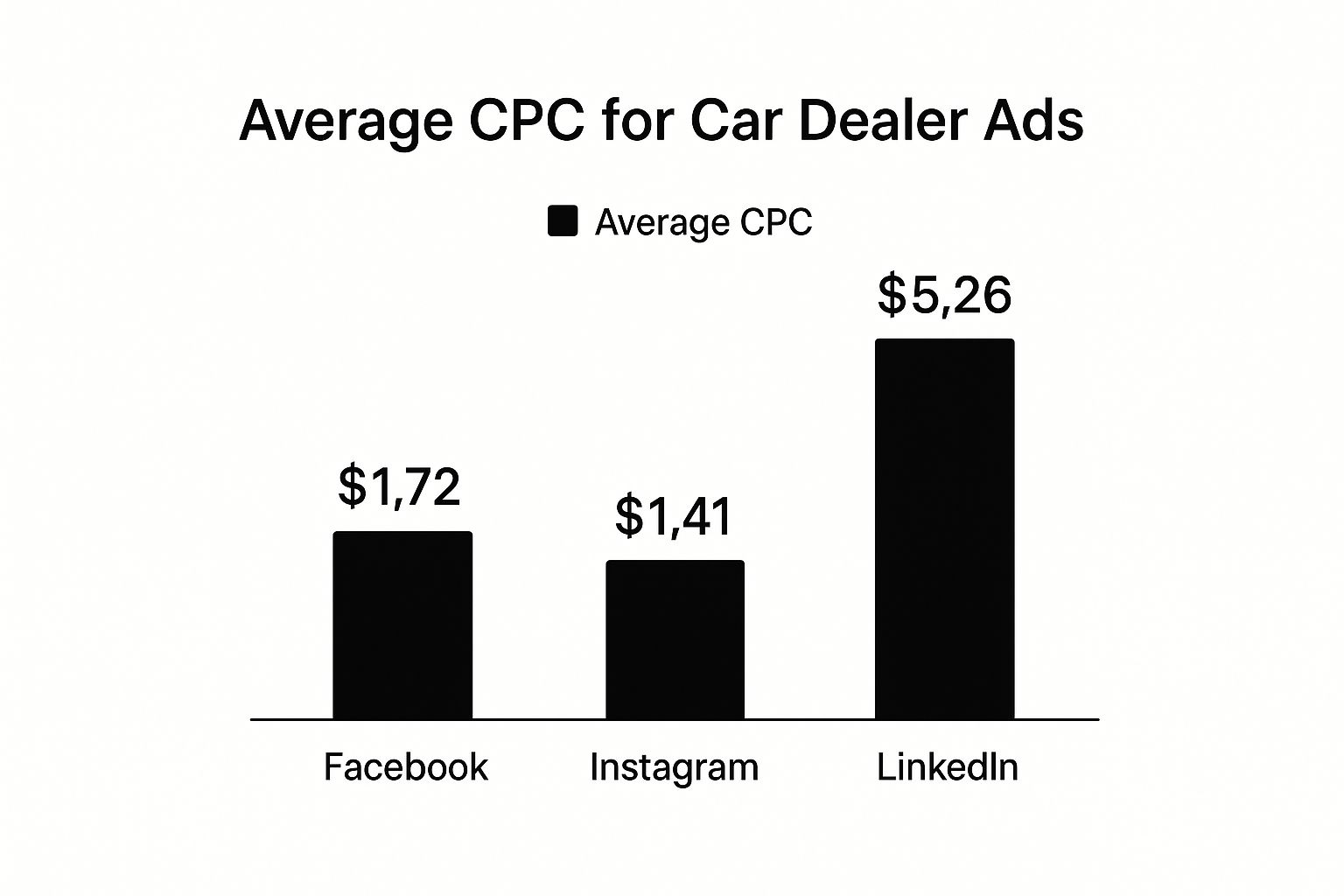
As the data makes clear, Instagram and Facebook give you a much more cost-effective way to get clicks compared to a professional networking site like LinkedIn. For reaching consumer car buyers, they are the obvious choice.
Dealership Ad Campaign Objective Comparison
Choosing the right campaign objective is just as important as your targeting and creative. This isn't a one-size-fits-all situation; the objective you select tells the platform what you want to achieve, and it will optimize your ad delivery accordingly. Here's a quick breakdown of the most common objectives and when you should use them for your dealership.
| Ad Objective | Best Used For | Key Metric to Track |
|---|---|---|
| Lead Generation | Capturing contact info (name, email, phone) directly within the platform using native forms. Ideal for building your sales pipeline. | Cost Per Lead (CPL) |
| Traffic | Driving users from the social platform to a specific page on your dealership's website, like a Vehicle Detail Page (VDP) or a specials page. | Cost Per Click (CPC) |
| Engagement | Getting more likes, comments, shares, and event responses on a specific post. Best for building community and promoting sales events. | Cost Per Engagement |
Each objective serves a distinct purpose. While Lead Generation is often the go-to for immediate sales opportunities, don't discount the value of a well-run Traffic or Engagement campaign to build your brand and fill the top of your funnel. The key is to align your objective with your specific business goal for that campaign.
Finally, always have a crystal-clear call-to-action (CTA) and make the next step as simple as possible. Facebook's built-in lead forms are brilliant for this. They allow a user to submit their contact info without ever having to leave the app, which dramatically reduces friction and can send your conversion rates through the roof.
To see how all these pieces come together in powerful, lead-generating campaigns, you can explore our complete guide on dealership Facebook ads.
Build a Loyal Community and Manage Your Reputation
Let's get one thing straight: social media is for relationships, not just broadcasting your latest ad. For car dealers, the 'social' part is your single greatest asset for building a loyal customer base that keeps coming back and sending their friends your way. It all boils down to two things: active engagement and protecting your reputation like a hawk.
Think of your comments section and DMs as an extension of your showroom floor. When someone asks a question or leaves a comment, they expect you to notice. Ignoring them is the digital equivalent of turning your back on a customer standing right in front of your desk. Responding quickly and helpfully isn't optional; it's the cost of entry.
Mastering Community Engagement
Proactive engagement is how you turn passive followers into a real community. It’s about starting conversations and making people feel like they’re part of something, not just a number on your follower count. This is where you graduate from simply posting inventory pictures to building actual connections.
I’ve seen dealerships get huge results with a few simple, powerful tactics:
- Run Local Contests. Team up with another local business—a popular restaurant or a local sports team—for a giveaway. A free detail service paired with a dinner voucher can generate more authentic local buzz than a thousand-dollar ad spend.
- Feature Your Customers. This one's a no-brainer. When a happy customer tags your dealership in a photo with their brand-new ride, celebrate it! Reshare that post to your stories and your main feed. That kind of authentic social proof is more powerful than any slick ad you can create.
- Ask Engaging Questions. It doesn't have to be complicated. Post a poll asking, "What's the best road trip you've ever taken?" These simple questions get people talking and build a sense of community around your brand.
Handling Feedback and Protecting Your Reputation
Your online reputation isn't built on five-star reviews alone; it's forged in how you handle all feedback, especially the negative stuff. A bad comment isn't a crisis. It's a golden opportunity to show everyone watching that you're committed to incredible customer service. The trick is to respond fast, stay professional, and be transparent.
Never, ever delete a negative comment unless it's spammy or uses offensive language. Instead, acknowledge the issue publicly with a calm, helpful reply. Something like, "We're sorry to hear about your experience. Please send us a direct message with your contact info so our manager can reach out and make this right." Then, take the conversation private.
This simple act shows the hundreds—or thousands—of other people reading that you take customer concerns seriously. Don't forget, what people see online directly influences where they buy. Statistics show that by 2025, 76% of users will have made a purchase based on a social media post. That number highlights just how much power these platforms have over your next sale. To learn more about where things are headed, you can explore more about these social media trends and their impact. A polished, responsive presence is often the very first impression a potential buyer has of your dealership—make it a good one.
Tracking Performance and Proving Your ROI
How do you prove your social media marketing is actually selling cars? This is where we connect every post, ad, and comment back to your bottom line. Success isn't about likes and shares; it’s about booked appointments and sold vehicles.
The real key is to stop obsessing over vanity metrics and start focusing on the numbers that matter to your General Manager. By meshing your platform analytics with your dealership's CRM, you can draw a straight line from a Facebook click directly to a closed deal. This simple process flips your marketing from a line-item expense into a measurable, revenue-generating investment.
Your goal should be to walk into any meeting and confidently say, "For every dollar we spent on social last month, we generated $X in gross profit." That's the real power of solid tracking.
Connecting Social Activity to Actual Sales
First things first: every single link you share must be trackable. This is non-negotiable. Using UTM parameters—basically short tracking codes added to a URL—is how you do it. These codes tell Google Analytics exactly where a visitor came from, which specific campaign they clicked, and even which ad creative caught their eye.
This data is pure gold.
When a lead comes through your website from a social media link, that UTM info gets captured right inside your CRM along with their contact details. Boom. You've got a direct connection.
- Platform Analytics: Keep an eye on your Cost Per Lead (CPL) and Click-Through Rate (CTR) inside Facebook and Instagram. This tells you how efficiently your ads are grabbing that initial interest.
- Google Analytics: Watch how your social media traffic behaves on your website. Are they clicking through multiple VDPs? Are they spending time on your financing page? This is where you separate tire-kickers from real buyers.
- CRM Data: This is the final piece of the puzzle. You match the leads captured with UTM data to the actual sales records in your CRM. This lets you calculate the one metric that truly matters: Return on Ad Spend (ROAS).
Calculating Your True ROI
Once your tracking is dialed in, figuring out your ROI becomes pretty straightforward. You can finally see which platforms are driving the most qualified leads and which campaigns are delivering the highest closing ratios.
You might discover that your quick Instagram Reel walkarounds are leading to way more test drives than your static Facebook posts. That’s an insight you can act on immediately.
This data-driven approach means you can fine-tune your strategy in real-time. Double down on what's working, and cut what isn't. It’s all about making your budget work smarter, not harder.
For a complete framework on this, our guide on marketing ROI measurement offers a much deeper dive into the essential formulas and tools. By mastering these metrics, you can confidently justify your marketing spend and prove the massive value your social media efforts are bringing to the dealership.
Common Questions About Social Media for Car Dealers
Even with a great game plan, you're bound to have questions. We get it. Here are some quick answers to the questions we hear most often from dealers who are serious about making social media work for them.
How Much Should a Dealership Spend on Social Media?
There’s no magic number here. Your budget really depends on your dealership’s size, your specific market, and what you’re trying to accomplish.
As a solid starting point, think about setting aside 10-15% of your total marketing budget for social media.
The smart move is to start with a smaller, highly focused ad spend. Use it to test out different audiences, ad creatives, and offers. Once you have the data showing a clear return—tracked leads, appointments, and actual sales—you can confidently start putting more fuel on the fire.
The best social media strategies are driven by data, not guesswork. Start small, prove what works, and then double down on the campaigns that are actually putting people in the showroom.
Which Social Platform Sells the Most Cars?
For most dealerships, Facebook and Instagram are still the heavy hitters when it comes to driving actual sales. There's just no substitute for Facebook's incredibly detailed ad targeting. You can zero in on local buyers based on their interests, what they've been searching for online, and even major life events like having a baby or getting a new job.
Instagram, on the other hand, is your visual showroom. It’s perfect for showing off your inventory with slick photos and eye-catching Reels. While a platform like TikTok is fantastic for building brand awareness with a younger crowd, Facebook and Instagram give you the most direct, measurable path to generating real leads.
How Often Should a Car Dealership Post?
Consistency is way more important than frequency. It’s better to post quality content reliably than to just throw things at the wall every single day. Find a posting rhythm your team can actually stick with for the long haul.
A great place to start is posting 3-5 times per week on your main channels like Facebook and Instagram.
The key is to create a healthy mix of content so you don't bore your audience. Show off new inventory, give a behind-the-scenes look at the dealership, share customer testimonials, and promote your service specials. A simple content calendar makes this whole process a lot easier to manage.
Ready to turn social media clicks into actual sales? The team at Willowood Ventures specializes in creating high-impact Facebook Sales Events that drive hundreds of qualified buyers right to your door. Learn how our turn-key solution can boost your showroom traffic and gross revenue.