

In the car business, your first impression happens online, long before anyone steps through your showroom doors. Auto dealer reputation management isn’t some fluffy marketing term anymore—it’s a core part of your operation. It’s about actively keeping an eye on, shaping, and defending your dealership’s image where it matters most: on review sites, social media, and forums. It’s how you build trust before you even get a chance to shake a customer’s hand.
Why Your Online Reputation Is the New Showroom
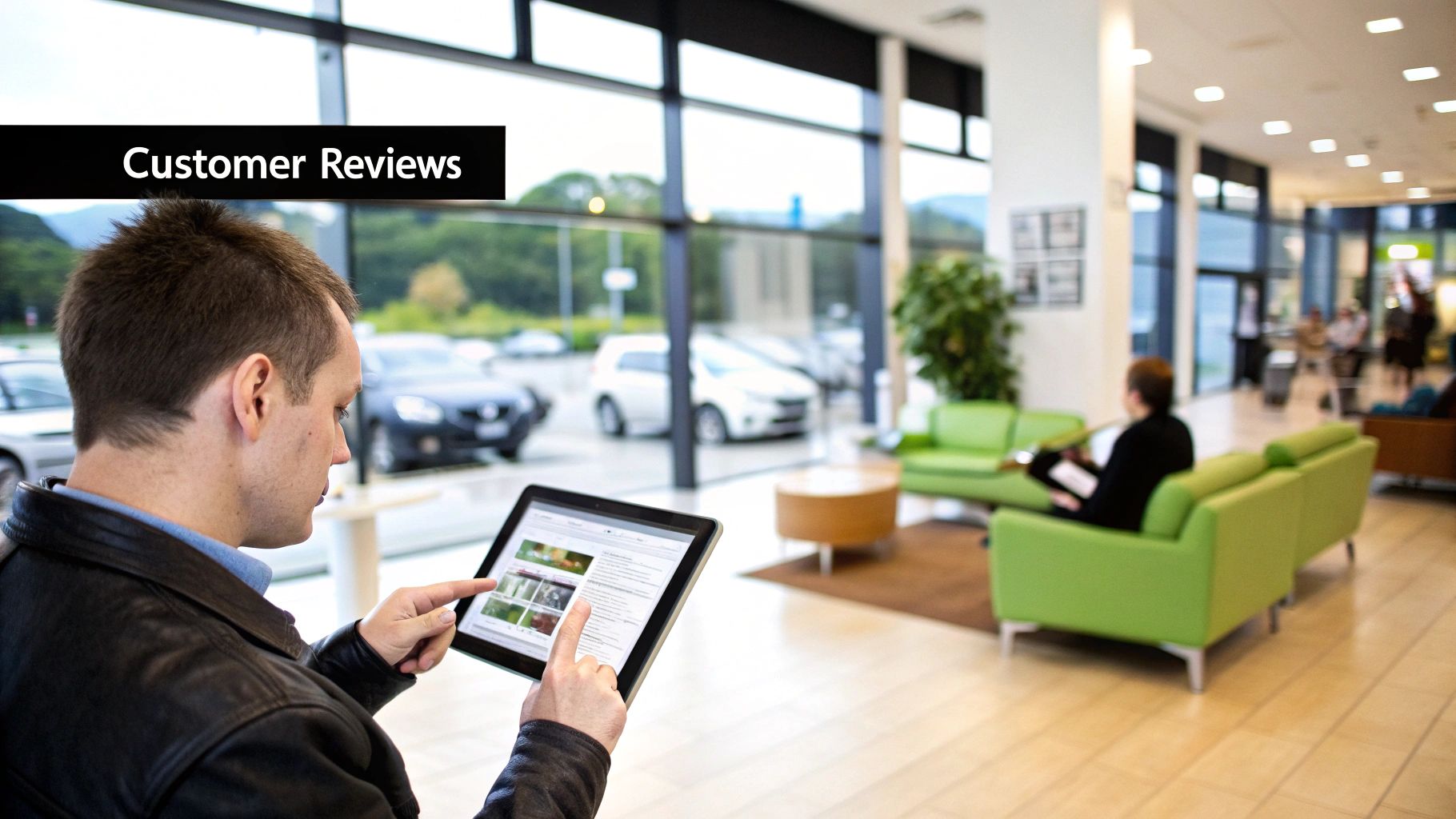
Think about it. Before a potential buyer decides to drive down to your lot, they’ve already taken a full tour of your digital showroom. What they find—whether it’s a string of five-star reviews, a few angry and unanswered complaints, or just dead silence—is already shaping their decision. That first online handshake is a make-or-break moment.
The modern car buying journey starts with a Google search, not a trip down the street. The numbers back this up in a big way. One study found that 95% of automotive shoppers lean on online resources first, rather than heading straight to a dealership. Even more telling, a massive 91% of them use reviews to size you up. Ignoring this is like locking the front doors and expecting customers to find another way in. For a deeper dive into these changing habits, check out these automotive reputation management insights.
A dealership’s reputation directly influences everything from lead volume to final sale price. The table below breaks down just how critical this is.
How Reputation Impacts Key Dealership Metrics
| Metric | Impact of Strong Reputation Management | Impact of Neglected Reputation |
|---|---|---|
| Lead Generation | Higher local search rankings mean more eyes on your inventory and more inbound calls. | You become invisible to in-market shoppers searching for local dealers. |
| Customer Trust | Shoppers arrive pre-sold, confident in your team and your promises. | Buyers are skeptical from the start, questioning every part of the deal. |
| Sales Conversion | The sales process is smoother with less haggling and higher grosses. | Deals are harder to close, often requiring deep discounts to overcome mistrust. |
| Staff Morale | The team feels proud and motivated, backed by positive public perception. | Salespeople constantly fight uphill battles, leading to burnout and turnover. |
Ultimately, a strong online presence acts as a powerful force multiplier for your sales and marketing efforts, while a poor one undermines every other investment you make.
The Direct Impact on Your Bottom Line
Every single review, good or bad, adds to the story people tell about your dealership. A steady flow of positive feedback is powerful social proof. It tells new customers that you’re trustworthy and deliver on your promises, backing up what your sales team and your ads are saying.
The impact is immediate and measurable:
- Better Leads: Great ratings on your Google Business Profile boost your local search ranking, putting your dealership right in front of active shoppers.
- Stronger Trust: When you respond to all feedback—the good, the bad, and the ugly—it shows you care. That transparency can be the deciding factor for a buyer on the fence.
- Easier Sales: A solid reputation pre-sells your dealership. Customers walk in with more confidence and less friction, which means a smoother, faster sales process.
Your online reputation is a living, breathing asset that works for you 24/7. It’s the silent salesperson influencing hundreds of potential buyers you’ll never even know were considering you.
From Reviews to Relationships
Good reputation management is more than just damage control. It’s about relationship building. When you take the time to thoughtfully reply to a negative review or genuinely thank a customer for their praise, you’re having a public conversation. Everyone sees it, and it says more about your dealership’s culture than any billboard ever could.
This whole process ties directly into your other digital efforts. Knowing the ins and outs of social media marketing best practices can seriously amplify your results. Being authentic in these public forums builds a real community around your brand, turning one-time customers into loyal advocates who will go to bat for you. That proactive engagement is what separates the top-performing dealers from everyone else.
Building Your Customer Feedback Monitoring System
An effective reputation management strategy starts with one simple thing: listening. You can’t fix problems you don’t know exist, and these days, customers are talking about their experiences on more platforms than ever. Getting a systematic monitoring process in place is the only way to make sure nothing slips through the cracks.
While Google and Facebook are the obvious heavyweights, you have to look beyond them. Automotive-specific sites like DealerRater, Cars.com, and Edmunds carry serious clout with buyers who are deep in the shopping process. These are the platforms where people go for detailed, industry-specific feedback, making your presence—and your responsiveness—absolutely critical.
Setting Up Your Listening Posts
First things first, you need to cast a wide net. Manually checking every single review site every day is a recipe for burnout; it’s just not sustainable. What you need is a system that funnels all the important feedback right to you or a designated point person on your team.
At a minimum, you need to be watching these platforms:
- Google Business Profile: This is your digital storefront. For many customers, it’s the first impression they’ll ever have of you.
- Facebook: Reviews, comments, and mentions here are public and incredibly easy for people to share.
- Industry-Specific Sites: Again, this is where the serious shoppers live. Think DealerRater, Cars.com, and Edmunds.
- General Review Sites: Don’t sleep on sites like Yelp or the Better Business Bureau (BBB). They still matter.
This workflow gives you a clear picture of how to capture and make sense of all that feedback.
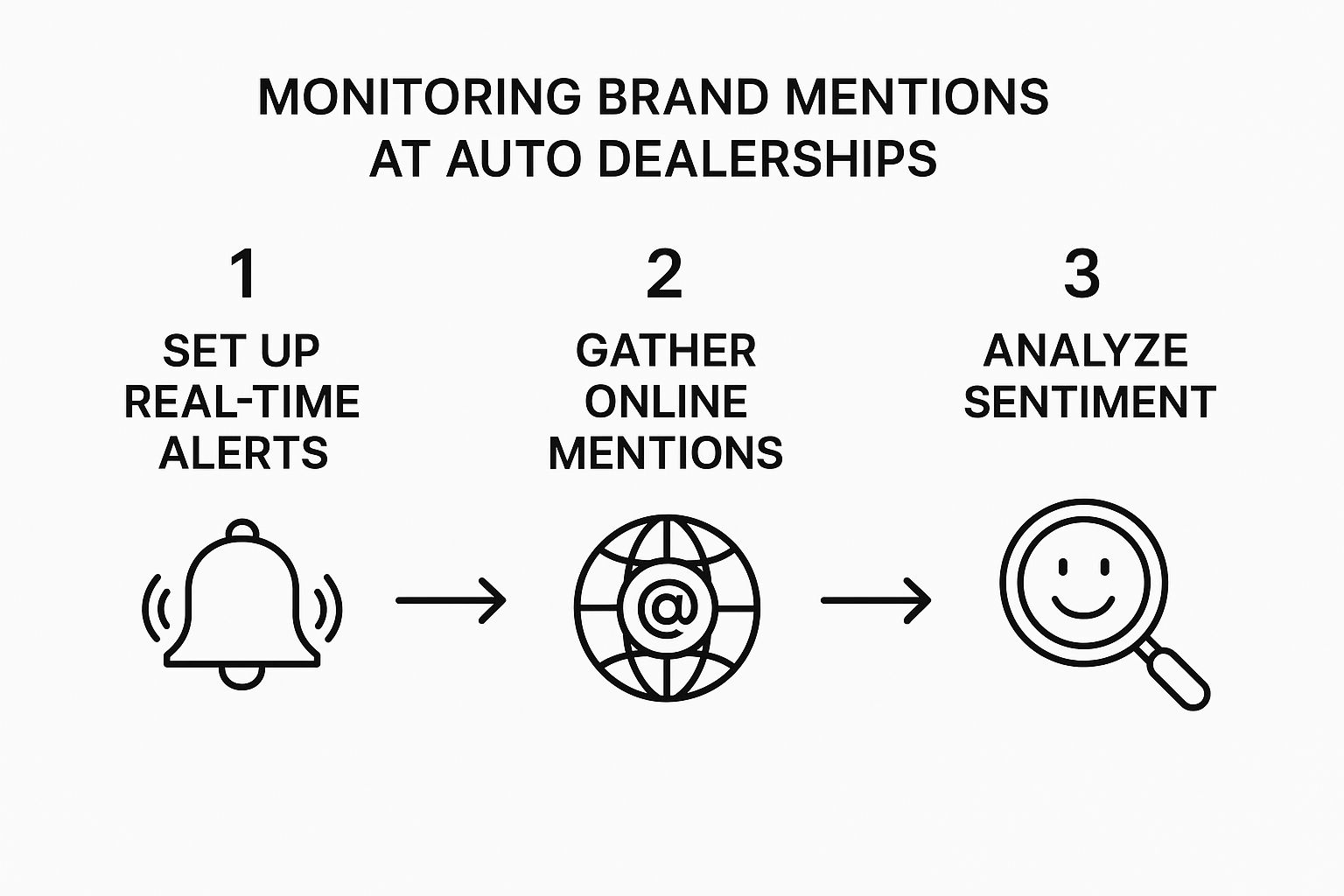
As you can see, it’s not just about collecting mentions. It’s about truly understanding the sentiment behind them so you can craft the right kind of response.
Choosing Your Monitoring Tools
Automating this whole process is the key to staying consistent. The good news is you have plenty of options, from free tools that cover the basics to sophisticated platforms built specifically for dealerships.
A fantastic—and free—place to start is Google Alerts. You can set up alerts for your dealership’s name, the name of your General Manager, and even common misspellings of your business. It’s a simple tool that emails you whenever your keywords pop up online, acting as a great first line of defense. As you scale up, you might also want to dig into how to add service areas to your Google Business Profile to catch more localized feedback.
Remember, speed is everything. Research shows that 89% of people read the responses businesses make to reviews. A fast, thoughtful reply to a negative comment can often neutralize its impact before it snowballs.
For a more powerful setup, specialized reputation management software is the way to go. These tools pull reviews from dozens of sites into one central dashboard. Many of them even offer sentiment analysis and automated reports, which can save your team a massive amount of time.
Assigning Clear Ownership
A system is useless without people to run it. The final piece of the puzzle is assigning clear responsibility for this process.
You need to designate a “Reputation Manager” or a small team to own it from start to finish. This person’s job is to:
- Check the monitoring dashboard every single day.
- Draft responses or assign them to the right person.
- Flag operational issues from reviews to the correct department head (e.g., a service complaint gets routed straight to the Service Director).
When someone is accountable, every piece of customer feedback—good or bad—becomes a valuable data point you can use to make the entire dealership better.
The Art of Responding to Online Reviews

Think of every online review as a public conversation. How you show up in that conversation tells potential customers everything they need to know about your dealership’s character. Ignoring feedback? That’s not an option anymore. A quick, professional response can turn a frustrated customer into a loyal advocate and impress the countless prospects watching from the sidelines.
You can’t use a one-size-fits-all approach. The way you handle a glowing five-star review is completely different from how you tackle a vague, three-star comment. One needs genuine gratitude that reinforces what you do well, while the other demands empathy and a clear path to making things right. Dropping the ball on positive reviews is a huge missed opportunity, and getting defensive with negative ones can torch your reputation instantly.
Responding to Positive Reviews
When a customer leaves a fantastic review, they’ve just handed you a free, high-powered marketing tool. Don’t just thank them—amplify their positive experience for everyone else to see. The key is to be specific, personal, and sincere.
- Mention the Details: A generic “Thanks for the review” is forgettable. Try something like, “We’re so glad Sarah in sales made your car buying experience a great one!” This gives a specific shout-out and reinforces your team’s amazing work.
- Make It Personal: Always use the reviewer’s name and sign off with your own name and title. It shows a real human is listening, not a bot.
- Invite Them Back: Wrap up your response with a friendly invitation to return for their first oil change or their next vehicle purchase.
This simple act of acknowledgment makes your happy customers feel seen and valued. It’s what turns them into repeat buyers and die-hard advocates for your dealership.
Handling Negative Feedback Gracefully
Look, negative reviews sting. But they’re also your single biggest opportunity to show just how committed you are to customer service. The goal isn’t to win an argument; it’s to demonstrate accountability and a genuine desire to fix the problem. Canned, robotic answers are your enemy here.
Your response has to be fast, empathetic, and focused on a solution. Start by acknowledging their frustration, then apologize for their experience—even if you feel there’s more to the story. This immediately de-escalates the tension and shows you’re taking their complaint seriously.
The single most important step is to take the conversation offline. Provide a direct contact—a specific person’s name, email, and phone number—to resolve the issue privately. This stops a public back-and-forth and proves you’re taking ownership.
For example: “John, we are very sorry to hear that your service appointment did not meet your expectations. This is not the standard we aim for. Please contact me directly at [phone number] so I can personally address this and work to make it right. – [Your Name], Service Manager.”
This simple, direct approach can completely turn a situation around. I’ve seen it time and time again: customers will actually go back and update their negative review to praise the excellent follow-up service they received.
Mastering this kind of communication is just as crucial as writing great sales outreach. If you want to make sure your entire communication strategy is solid, check out our guide to car sales email templates. At the end of the day, every single response you write is another chapter in your dealership’s story.
How to Proactively Generate More Positive Reviews
Sitting back and waiting for reviews to trickle in is a recipe for letting chance dictate your reputation. If you want to take control, you have to shift to a proactive strategy. That’s how you build a steady stream of positive feedback that not only builds trust but also gives your local search visibility a serious boost. The trick is making the review process a seamless, natural part of the customer experience.
Timing is everything. You want to ask when the customer’s satisfaction is peaking—what I call the “moment of maximum happiness.” This usually happens right after a smooth vehicle purchase or a hassle-free service appointment. A simple, personalized text or email sent within an hour of them leaving the dealership is incredibly powerful. You’re catching them while that positive experience is still fresh.
Make It Effortless for the Customer
The single biggest reason customers don’t leave reviews? Friction. If they have to hunt for your Google Business Profile or navigate a clunky website, they’re going to bail. You have to make it dead simple for them.
- Provide Direct Links: Every single review request needs to have direct links to your most important profiles—think Google, Facebook, and DealerRater. It removes all the guesswork.
- Set Clear Expectations: Let them know it’ll only take a minute. Something like, “Could you take 60 seconds to share your experience?” frames it as a small, easy favor, not a chore.
Remember, the goal isn’t just to ask; it’s to make leaving a review so easy that the customer has no reason to say no. A simple text with a direct link can change the game for your review volume.
A huge part of boosting your online presence is learning how to get customer reviews by timing your requests perfectly.
Automate the Ask Systematically
Trying to manually send review requests is a losing battle. It’s inefficient and always the first thing to get forgotten on a busy sales day. This is where automation becomes your best friend. Integrating review request software with your Dealer Management System (DMS) can trigger messages automatically the moment a deal is closed or a repair order is completed. For a deeper dive, check out this guide on mastering dealership email automation to get this process nailed down.
This kind of consistent, automated approach is what separates the average dealerships from the top performers. Widewail’s research is pretty clear on this: the average dealership gets about 11.5 online reviews per month. But dealers who actively use a reputation management platform? They’re pulling in an average of 35 reviews per month—that’s a threefold increase. You can read the full analysis on these automotive review performance findings on Widewail.com.
By making the “ask” a standard, automated part of your closing process, you build a powerful engine that generates positive feedback around the clock, working for you even when you’re not.
Using Technology for Smarter Reputation Management
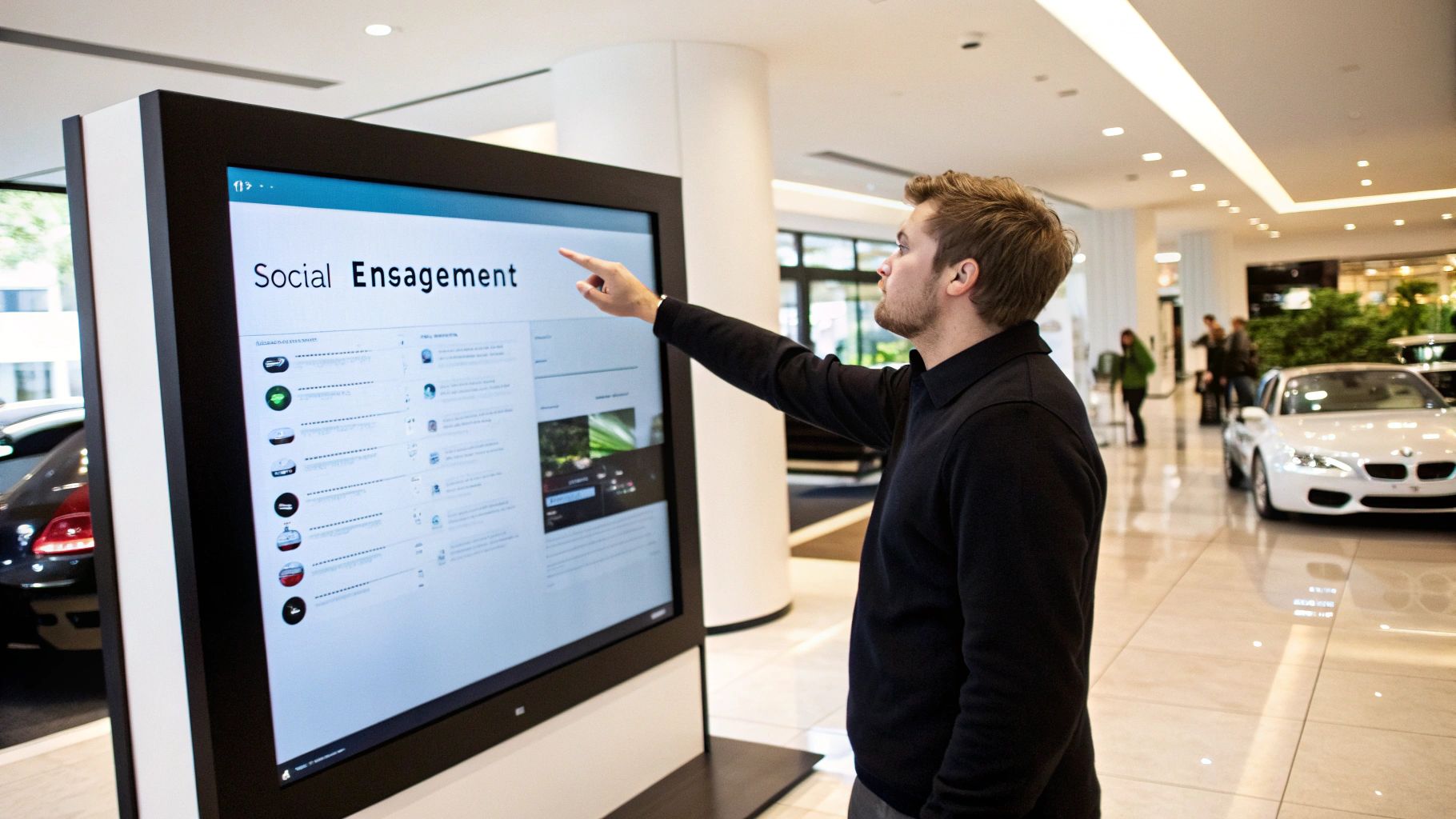
Let’s be honest. Manually tracking reviews across a dozen different platforms is a losing battle. It’s clunky, slow, and you’re guaranteed to miss the one piece of feedback that could have saved a customer relationship.
This is where specialized auto dealer reputation management software stops being a “nice to have” and becomes a core part of your dealership’s operations. It’s about flipping the script—moving from a reactive chore to a proactive strategy that gathers real business intelligence.
These platforms automate all the heavy lifting. Instead of an employee burning hours every day logging in and out of Google, Cars.com, and DealerRater, a single tool pulls every new review and rating into one unified dashboard. Having that immediate, centralized view is the first real step toward taking command of your dealership’s public image.
Must-Have Features in a Reputation Platform
When you’re shopping for software, it’s easy to get sidetracked by flashy features that don’t actually move the needle. You need to zero in on tools that save your team time and deliver tangible results.
The best platforms are built around a core set of functions that directly boost your ratings and make your team more efficient.
Here’s what to look for:
- Centralized Review Monitoring: This is non-negotiable. It has to pull feedback from all the key sites—Google, Facebook, Edmunds, DealerRater, you name it—in near real-time.
- Automated Review Requests: Look for a tool that plugs into your DMS or CRM. It should automatically ping customers via text or email right after a sale or service visit when they’re most likely to respond.
- Sentiment Analysis: This feature uses AI to quickly sort feedback into positive, negative, or neutral buckets. It’s how you spot trends before they become major problems.
- Customizable Response Templates: You need the ability to create pre-approved responses for common feedback. This keeps your brand voice consistent while still giving your team the flexibility to add a personal touch.
The right tech doesn’t just manage what people are saying; it gives you the data to make smarter decisions. This kind of insight is a close cousin to what you’d find in a well-managed automotive CRM, where every customer touchpoint is tracked to build stronger relationships.
https://willowoodventures.com/automotive-crm/
From Data Collection to Actionable Insights
The real magic of this technology is its ability to connect the dots in your customer feedback. Is your service department consistently praised for great communication, but the F&I process is a recurring source of frustration? Sentiment analysis will flag these patterns with pinpoint accuracy.
Suddenly, reviews aren’t just comments anymore. They’re valuable operational data. You can identify specific employees who are customer service rockstars or uncover bottlenecks in your process that are secretly tanking your reputation.
By looking at all your feedback in one place, you start to see trends that are completely invisible when you’re just reading one review at a time. This data becomes your roadmap for improving every single department, from the sales floor to the service drive.
The impact here is totally measurable. Just look at Widewail’s Q2 2025 Voice of the Customer report. It ranks the top U.S. auto groups using a score that heavily weights review volume and response rates. The number one group, Vaughan Automotive, scored a near-perfect 97/100. How? Through intense engagement and a consistent flow of new feedback. You can dive into the full automotive group rankings report on CBT News. It’s proof that a systematic, tech-powered approach to reputation is what separates the leaders from everyone else.
Of course. Here is the rewritten section, crafted to sound like an experienced human expert and match the provided examples.
Tackling the Tough Reputation Management Questions
When you’re managing your dealership’s online reputation, you’re going to run into some tricky situations. It’s just part of the game. Having a solid game plan for these common challenges means your team can react quickly and professionally, turning a potential fire into a chance to show everyone how much you care about your customers.
Let’s dive into a few of the questions that always seem to pop up when we’re talking about protecting and building a dealership’s brand online.
What’s the Right Way to Handle a Fake or Malicious Review?
First off, take a deep breath and step away from the keyboard. The absolute worst thing you can do is fire back an emotional response. Getting into a public mud-slinging match only makes you look bad and gives the fake review more credibility than it deserves.
Every major platform, including Google, has a formal process to flag reviews that violate their rules. Use it. That’s your first move, every single time.
While the platform does its thing, you still need to respond publicly—but only once. Keep it calm, professional, and to the point. Something like this works wonders:
“Thank you for bringing this to our attention. We’ve looked through our sales and service records and can’t find a customer that matches your name or the situation you’ve described. We take all feedback seriously and would appreciate it if you could contact our general manager directly to help us understand the issue.”
This response does a few brilliant things. It shows prospective customers that you’re on top of your feedback, you’re professional, and you’re willing to solve problems. It also subtly signals that the review might not be legitimate, all without getting into an argument. You’ve managed the damage while you work behind the scenes to get it taken down.
Is It Better to Have a Few Perfect Reviews or a Ton of Great Ones?
This one’s easy: volume and authenticity almost always win. It’s far better to have a large number of recent reviews with a strong—but not flawless—average, like a 4.5 to 4.7-star rating. This provides a ton of social proof and tells a story of a consistently positive experience.
Think about it from a buyer’s perspective. A perfect 5.0 score from only a handful of reviews can feel a bit suspicious. No business that’s been around for a while is perfect, and savvy shoppers know it. A high volume of reviews with a slightly imperfect score feels more real and trustworthy. It shows you’re a thriving, active dealership that deals with real people every day.
How Much Time Should We Be Spending on This Every Week?
The exact time depends on your store’s size and how many reviews you’re getting, but a solid starting point is 30-60 minutes every single day. The secret isn’t blocking off a whole afternoon; it’s consistency. Making reputation management a daily ritual is what builds and maintains a responsive, positive presence.
Use that daily block of time for a few critical tasks:
- Scan for new reviews across Google, Facebook, DealerRater, and wherever else customers are talking about you.
- Write and post thoughtful replies to both the happy and the unhappy customers.
- Glance at the performance of your review request campaigns to make sure they’re still working.
By chipping away at it every day, you guarantee that no customer feels ignored. This simple, consistent effort is what separates the top-rated dealers from the rest. It shows every single person who finds you online that you’re listening.
Ready to turn online engagement into real showroom traffic? The team at Willowood Ventures specializes in creating high-impact sales events that drive hundreds of qualified buyers to your dealership. Discover how our proven strategies can deliver measurable ROI by visiting us at https://www.willowoodventures.com.