
Measuring your marketing ROI is simply the process of connecting profit and revenue growth directly to your marketing efforts. It’s how you stop guessing and start knowing. It provides a clear, data-backed answer to whether your marketing dollars are actually working, which is exactly what you need to justify budgets and fine-tune future campaigns.
Why Accurate Marketing ROI Measurement Is Non-Negotiable

Let’s be honest. Proving your department’s worth usually boils down to one thing: showing a return on investment. In today’s business climate, you have to master marketing ROI measurement to survive and grow. It’s no longer good enough to just launch creative campaigns; you must prove their financial impact.
When you have solid ROI data, it completely changes the conversation. It directly influences budget approvals, helps you build winning strategies, and creates unshakable trust with leadership. It’s all about shifting marketing from a line-item cost to a powerful, predictable revenue driver. That’s the real-world pressure marketers face every single day.
From Cost Center to Revenue Driver
This pressure to prove value is everywhere, across all industries. It’s especially true in sectors going through rapid change, where every single dollar counts. Take the ongoing https://willowoodventures.com/automotive-digital-transformation/ for example. It has forced car dealerships to scrutinize their marketing spend like never before. They absolutely have to know which online strategies are the ones actually bringing buyers into the showroom.
But this trend isn’t isolated to automotive. Marketing leaders now rank demonstrating ROI as their top priority. In fact, 83% of them feel this way, a huge jump from just 68% five years ago. On top of that, an estimated 64% of companies now base their future marketing budgets directly on the ROI from previous campaigns. This shows a clear and decisive shift toward data-driven accountability.
We can see how much this trend is reshaping budget discussions by looking at some key benchmarks for different channels.
Key Marketing Channel ROI Benchmarks
Here’s a quick look at the average return on investment for some of the most popular marketing channels. This gives you a baseline for what “good” can look like, though your own results will obviously vary based on your industry, execution, and audience.
| Marketing Channel | Average Return per $1 Spent |
|---|---|
| Email Marketing | $36 |
| SEO | $22 |
| Content Marketing | $8 |
| Social Media Marketing (Paid) | $5 |
| PPC Advertising (Google Ads) | $2 |
These numbers highlight why channels like email and SEO are often praised for their efficiency. However, a lower ROI doesn’t mean a channel is “bad”—it just means its role might be more focused on brand awareness or top-of-funnel engagement rather than direct sales. Understanding this context is crucial.
Key Takeaway: Effective ROI measurement isn’t just about reporting numbers. It’s a strategic tool that validates your team’s contribution, secures the funding you need, and steers your entire marketing program toward real profitability.
The Foundation of Strategic Decisions
Without clear ROI metrics, you’re flying blind. You could be pouring money into a channel that feels busy and successful but is actually underperforming, while a less glamorous tactic is secretly driving serious revenue. Accurate measurement cuts through the noise and gives you the clarity to make confident decisions.
Here’s how it empowers you:
- Spot the Winners: Pinpoint exactly which campaigns and channels deliver the best returns.
- Fix the Losers: Reallocate budget or overhaul strategies that aren’t hitting their financial targets.
- Forecast with Confidence: Use your historical ROI data to project future results and set realistic goals.
Ultimately, every piece of advice in this guide is built on this one simple, non-negotiable truth: you have to connect your marketing actions to bottom-line results.
Choosing KPIs That Actually Tell Your ROI Story
Before you can get a real number on your return, you have to measure what actually matters. Calculating marketing ROI starts with picking Key Performance Indicators (KPIs) that draw a straight line from your marketing efforts to real business results—not just the surface-level vanity metrics.
It’s tempting to get sidetracked by big, impressive numbers like social media likes or impressions. Sure, they can signal reach, but they don’t tell you if you’re actually making money. The trick is to match your KPIs to the specific goal of each campaign. You need a clear line of sight from your actions to your revenue.
Aligning KPIs with Campaign Goals
Your KPIs have to be a direct reflection of what “success” means for that specific marketing push. A campaign built to grow brand awareness is going to have totally different success metrics than one designed for direct sales. This is where a lot of ROI calculations go wrong—the metrics don’t match the mission.
Let’s say a dealership wants to get its name out there and become a local authority. They might track things like:
- Share of Voice (SOV): How often is your brand mentioned online compared to the competition?
- Website Traffic from Organic Search: A jump here suggests more people know your name and are actively looking for you.
- Branded Search Volume: How many people are typing your dealership’s name directly into Google?
On the flip side, a campaign laser-focused on sales needs to track what’s happening at the bottom of the funnel. This is especially true for highly targeted campaigns, like measuring the impact of different strategies for automotive lead generation. Success here isn’t about clicks; it’s about creating genuine sales opportunities.
For a sales-driven campaign, you’d be looking at:
- Cost Per Qualified Lead (CPQL): How much does it cost to get a lead that the sales team has actually vetted and accepted?
- Lead-to-Appointment Rate: What percentage of those qualified leads actually book a visit to the showroom?
- Customer Acquisition Cost (CAC): What’s the total marketing and sales spend to bring one new customer through the door?
This distinction is absolutely critical. Picking the right KPIs ensures the data you collect is a true reflection of your marketing’s impact on the bottom line. It gives you a solid foundation for any ROI calculation you run.
From Vague Metrics to Actionable Data
Trying to pin down marketing ROI is a headache felt in every industry, but it’s a massive challenge in the tech world where proving the financial impact of complex projects is a constant battle. In fact, Gartner’s Tech Marketing Benchmarks Survey found that ‘proving ROI with analytics’ is a top-three challenge for marketers in large tech companies, especially for things like brand awareness.
This is exactly why you have to get specific. Stop tracking “leads” and start tracking “Sales Qualified Leads (SQLs).” Forget “website engagement” and start measuring “demo request form completions.” As artificial intelligence becomes a bigger part of our marketing toolkit, getting familiar with specific metrics like Return on AI (ROAI) is essential for painting the full picture.
This level of detail turns your data from a simple report card into a strategic roadmap. It doesn’t just tell you what happened; it gives you clues about why it happened. That’s how you make smarter, more profitable decisions for your next campaign.
Your Toolkit For Reliable Data Collection

Let’s be blunt: your marketing ROI measurement is useless without trustworthy data. The calculations you run are only as good as the numbers you plug into them. This makes a rock-solid data collection process the absolute bedrock of your entire strategy.
Think of it less as a single tool and more like an integrated toolkit where every piece works together. You have to connect the dots between how someone discovers your brand and what they do once they become a paying customer. If you can’t build that bridge, your ROI will always be a shot in the dark.
Core Platforms For A Unified View
The biggest enemy here is data silos—information trapped in separate systems that don’t talk to each other. Your goal is to break down those walls. The essential toolkit for this combines web analytics with customer relationship management, creating a seamless flow of information from first click to final sale.
- Google Analytics (GA4): This is your window into website traffic, user behavior, and on-site conversions. It tells you where your visitors came from and what they did—whether they filled out a demo request, downloaded an ebook, or just browsed around.
- Customer Relationship Management (CRM): A CRM like HubSpot or Salesforce is where the story continues after that initial conversion. It tracks the entire sales journey, from lead status to deal value, and ultimately, the real revenue generated from that person. For a deep dive into how CRMs can supercharge your data collection, especially in service-oriented businesses, check out this guide on the best CRM for call center solutions.
Getting these two systems to communicate is non-negotiable. When your CRM and GA4 are integrated, you can finally trace a closed-won deal all the way back to the exact marketing channel that brought them to you.
Pro Tip: Don’t stop at just tracking top-line revenue. Dig deeper into metrics like Customer Lifetime Value (CLV) in your CRM. You might find that a customer who came from a blog post has a much higher long-term value than one from a paid ad. That’s a critical insight for real ROI analysis.
Pinpointing Campaign Performance With UTMs
So, how do you tell Google Analytics whether a visitor came from a specific email, a Facebook post, or a particular ad campaign? The answer is Urchin Tracking Module (UTM) parameters.
These are simple tags you add to the end of your URLs to get incredibly granular tracking. They’re a total big win.
A properly tagged URL can tell you:
- The Source: Where the traffic originated (e.g.,
google,facebook,newsletter). - The Medium: The marketing channel type (e.g.,
cpc,organic,email). - The Campaign: The specific marketing effort you’re running (e.g.,
summer_sale_2024,new_product_launch).
Using UTMs consistently across every single campaign transforms your vague traffic data into a clean, organized report. It shows you exactly which initiatives are driving results, giving you the confidence to invest more in what works and kill what doesn’t. This precise attribution is the key to accurate marketing ROI measurement.
Adding matchback reporting connects campaign contacts with dealership sales records, helping you assess which marketing activity is associated with completed vehicle purchases.
Calculating ROI With Real-World Scenarios
Theory is one thing, but making marketing ROI measurement work in the real world is what really separates the winners from the rest. This is where we stop talking about abstract ideas and start plugging in the kind of numbers you actually see day-to-day.
The basic formula itself is pretty simple:
(Revenue Generated – Marketing Investment) / Marketing Investment
Let’s run through a couple of common marketing initiatives to see how this plays out in real life.
Google Ads Campaign ROI
Picture a car dealership running a Google Ads campaign to get more people in the door for a test drive. The breakdown might look something like this:
- Total Ad Spend: $5,000
- Agency Management Fee: $1,500
- Total Leads Generated: 50
- Leads Converted to Sales: 8
- Average Profit Per Vehicle Sale: $3,000
First things first, you need your total investment. And don’t forget the agency fee—that’s a classic mistake. It’s a real cost of the campaign.
Total Investment = $5,000 + $1,500 = $6,500
Next, you tally up the revenue.
Total Revenue = 8 sales * $3,000 profit/sale = $24,000
Now, just plug those numbers into the ROI formula:
($24,000 – $6,500) / $6,500 = 2.69 or 269% ROI
What does that number mean? For every single dollar you put into that campaign, you got $2.69 back in pure profit. Not bad at all.
Email Marketing Sequence ROI
Let’s switch gears and look at an email campaign. Maybe you’re trying to win back some old customers. The costs here are usually much lower, often boiling down to platform fees and the time you put in.
- Email Platform Monthly Cost: $200
- Time Spent on Campaign (5 hours @ $50/hr): $250
- Total Sales Attributed to Email Clicks: 12
- Average Order Value: $450
Let’s calculate the total investment.
Total Investment = $200 + $250 = $450
And now for the revenue generated from those clicks.
Total Revenue = 12 sales * $450/sale = $5,400
Finally, let’s see the ROI.
($5,400 – $450) / $450 = 11 or 1100% ROI
An 1100% ROI is incredible, and it shows just how powerful a well-executed email campaign can be, especially when your initial costs are low.
This whole process, from setting your goals to crunching the final numbers, follows a clear path.
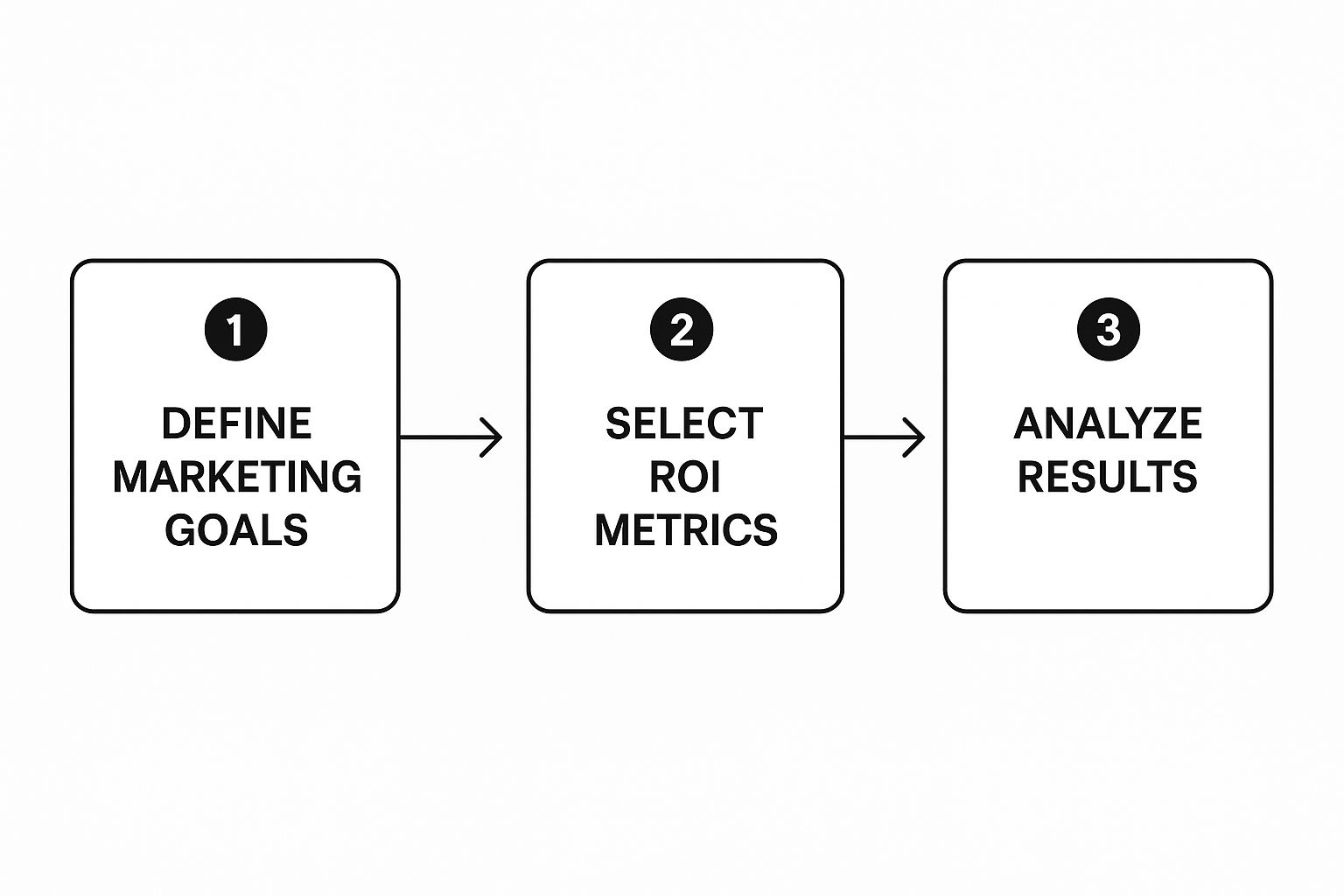
This isn’t just about doing math. It’s about having a structured process to make sure your calculations are built on a solid strategic foundation from the very beginning.
Factoring In Complex Costs
Things get a bit murkier when you start trying to measure the ROI of long-term efforts, like a content marketing strategy. The return isn’t immediate, and the costs are spread out and less direct.
A common mistake is only counting direct ad spend while ignoring the cost of people and tools. To get a true ROI, you must include team salaries (or a portion of them), software subscriptions, and freelance fees. This gives you a complete picture of your total investment.
For something like content marketing, your investment bucket is much bigger. It includes:
- Writer & Editor Salaries/Fees
- SEO & Analytics Software
- Time for Strategy and Promotion
Calculating ROI for these long-haul strategies requires a different lens. For a deeper look at methodologies, particularly for SEO, check out this guide on how to calculate SEO ROI. The framework it provides is practical and can be adapted to other long-term marketing efforts.
While these calculations can feel overwhelming, tools can simplify the number-crunching. For instance, using a straightforward https://willowoodventures.com/roi-calculator/ lets you quickly run different scenarios to see the potential return on your campaigns. It handles the math so you can focus on what the numbers are telling you.
How To Analyze Results And Avoid Common Pitfalls

So, you have your ROI number. That’s a great first step, but it’s just that—a first step. The real magic in marketing ROI measurement happens when you dig into that number and turn it into smarter, more profitable decisions.
Don’t just stare at the big, blended ROI figure. You need to segment your results. Break it down by channel, by campaign, and even by customer segment. You might discover your overall ROI is a solid 300%, but a closer look reveals one channel is an 800% rockstar while another is barely breaking even. This is the kind of detail that lets you confidently spot your heavy hitters and cut the budget drains.
Moving Beyond Short-Term Wins
One of the most common traps I see is an obsession with short-term gains. A campaign with a low immediate ROI isn’t always a failure. It might be quietly building brand equity or attracting customers with a much higher lifetime value (CLV). Content marketing, for example, often takes months to show a direct return, but the customers it brings in can be incredibly loyal and profitable over the long haul.
Another major pitfall is analyzing your channels in total isolation. As Nielsen’s Annual Marketing Report points out, siloed metrics don’t tell the whole story. Customers today bounce between different touchpoints before they ever make a purchase, and looking at each one separately gives you a fractured, often misleading picture.
Think about it. A customer might see a Facebook ad, read one of your blog posts, and then click a link in an email before buying. Giving 100% of the credit to that final email click completely ignores the crucial work social media and content did to get them there.
Common ROI Measurement Mistakes And How To Fix Them
I’ve seen the same mistakes trip people up time and time again. They’re easy to make but also completely avoidable if you know what to look for. This table breaks down some of the most frequent errors I encounter and, more importantly, how you can fix them.
| Common Mistake | Impact on Measurement | How to Fix It |
|---|---|---|
| Ignoring Customer Lifetime Value (CLV) | Under-valuing channels that acquire high-value, long-term customers. | Incorporate CLV into your ROI calculations. This gives a more accurate view of a channel’s true worth beyond the first purchase. |
| Using Only Last-Click Attribution | Giving all conversion credit to the final touchpoint, ignoring top-of-funnel efforts. | Implement a multi-touch attribution model (e.g., linear, time-decay) that assigns partial credit to each touchpoint in the customer journey. |
| Measuring Channels in Silos | Failing to see how different marketing channels influence each other. | Use analytics platforms that track cross-channel journeys. Analyze how channels like social media assist conversions driven by others like email or search. |
| Focusing Solely on Vanity Metrics | Relying on metrics like likes or impressions that don’t directly tie to revenue. | Prioritize action-oriented KPIs like conversion rate, cost per acquisition (CPA), and lead-to-customer rate. |
| Inconsistent Tracking & Reporting | Gaps or errors in data collection lead to unreliable and misleading ROI figures. | Standardize your tracking setup across all platforms using tools like Google Tag Manager. Conduct regular data audits to ensure accuracy. |
By side-stepping these common issues, your ROI analysis becomes a much more powerful and reliable tool for guiding your strategy. It’s about moving from simply reporting numbers to truly understanding what drives your business forward.
Turning Insights Into Action
Your analysis must always lead to action. The goal is to build a repeatable cycle of measuring, analyzing, and refining your marketing. This is especially true in competitive spaces, like automotive digital marketing, where every dollar has to pull its weight.
Here’s a simple, practical way to think about it:
- Double Down on Your Winners: Find your top-performing channels and campaigns. Can you scale the budget? Can you take what’s working there and apply it elsewhere?
- Fix or Cut the Losers: For the channels with weak ROI, dig in and find out why. Is it the audience? The creative? The offer? Try A/B testing some changes before you pull the plug completely.
- Evolve Your Attribution Model: If your analysis reveals a complex customer journey, that’s a clear sign your last-click model isn’t cutting it anymore. It’s time to explore a multi-touch model that gives credit where credit is due.
This kind of continuous improvement loop is what separates the pros from the amateurs. It ensures your marketing gets more efficient and effective over time, steering your business toward real, sustainable growth.
Frequently Asked Questions About Marketing ROI
Even with a solid framework for measuring ROI, you’re going to run into some tricky real-world questions. The daily grind of marketing is full of unique scenarios that don’t always fit neatly into a formula.
Let’s get into some of the most common ones I see trip marketers up. Getting these answers straight will help you navigate the nuances and make decisions with more confidence.
How Do I Measure ROI for Long-Term Strategies?
This is a big one, and for good reason. The return from something like SEO or content marketing isn’t immediate, which can make it tough to justify in the short term. Unlike a paid ad that drives a click today, a blog post’s value might build over months or even years. If you only look at it through a short-term lens, you’ll always sell it short.
The key here is to shift your focus from immediate sales to leading indicators and long-term value. You need to track the metrics that prove you’re building influence and momentum, even if the direct sales aren’t there yet.
Here are a few practical ways to do it:
- Track Organic Traffic Growth: Keep an eye on the steady increase in non-paid traffic to your key commercial pages and blog content. Think of this growth as an appreciating asset for the business.
- Attribute Assisted Conversions: Your analytics tools can show you how many customers interacted with a blog post or an organic landing page at any point before they eventually converted. It wasn’t the last click, but it was a critical step in their journey.
- Estimate Customer Lifetime Value (LTV): Dig into the numbers to calculate the average LTV of customers who first found you through organic search. You’ll often discover these customers are more loyal and bring in more profit over their lifetime.
What Is the Difference Between ROI and ROI?
It’s incredibly easy to mix these two up, but the distinction is critical for clear reporting and making smart decisions. The simplest way I explain it is this: ROI is a narrow, tactical metric, while ROI gives you the big-picture view of profitability.
ROI is laser-focused on the gross revenue generated for every dollar you spend on advertising. The formula is simple: (Ad Revenue / Ad Cost). This makes it the perfect tool for judging the direct performance of specific campaigns, like the targeted Facebook ads for car dealers that need to drive immediate traffic to an event.
Marketing ROI, on the other hand, is a much broader measure of your marketing’s overall profitability. It accounts for the entire cost of your marketing engine—not just ad spend, but also salaries, software subscriptions, and agency fees—and compares that to the profit you generated. It answers the fundamental question: Is our marketing department a net positive for the business?
Key Takeaway: Use ROI for your day-to-day campaign optimizations. Use ROI to assess the strategic health and true profitability of your entire marketing program.
How Often Should I Review My Marketing ROI?
There’s no single “right” answer here. The best cadence for reviewing ROI really depends on your campaign’s speed and your business cycle. Trying to apply a one-size-fits-all approach is a recipe for frustration.
Instead, think in tiers. A tiered review schedule helps you stay agile without overreacting to tiny, meaningless fluctuations.
Here’s a framework that works well:
- Weekly or Bi-Weekly: This is perfect for fast-moving paid media campaigns. Checking in this often lets you make quick tactical tweaks to bids, creative, and targeting based on what your ROI is telling you.
- Monthly: This is the ideal time to look at channel-level performance. You can zoom out a bit and assess the ROI of your email marketing, social media efforts, and other ongoing initiatives to see what’s really moving the needle.
- Quarterly: This is your strategic review. Now you’re looking at the big picture—overall marketing ROI, long-term trends from SEO and content marketing, and making major decisions about where to allocate your budget for the next quarter.
This structured approach keeps you from getting lost in the daily noise while ensuring you’re still nimble enough to pivot when it matters.
Ready to stop guessing and start driving predictable sales? Willowood Ventures transforms digital engagement into measurable showroom traffic. Our turn-key Facebook Sales Events generate 125-300+ qualified buyers, delivering a clear and impressive ROI. Learn how we can pack your dealership at https://www.willowoodventures.com.