

So, what exactly is “digital retailing” in the car world? It’s simply the shift of key parts of the car buying process online. Think about it: customers can now pick a vehicle, structure their deal, get pre-approved for financing, and even value their trade-in, all from their couch.
This isn’t about replacing your showroom. It’s about extending its reach and giving customers the flexible, modern experience they’ve come to expect everywhere else. It’s all about putting them back in the driver’s seat.
The Dealership Is Evolving, Not Disappearing
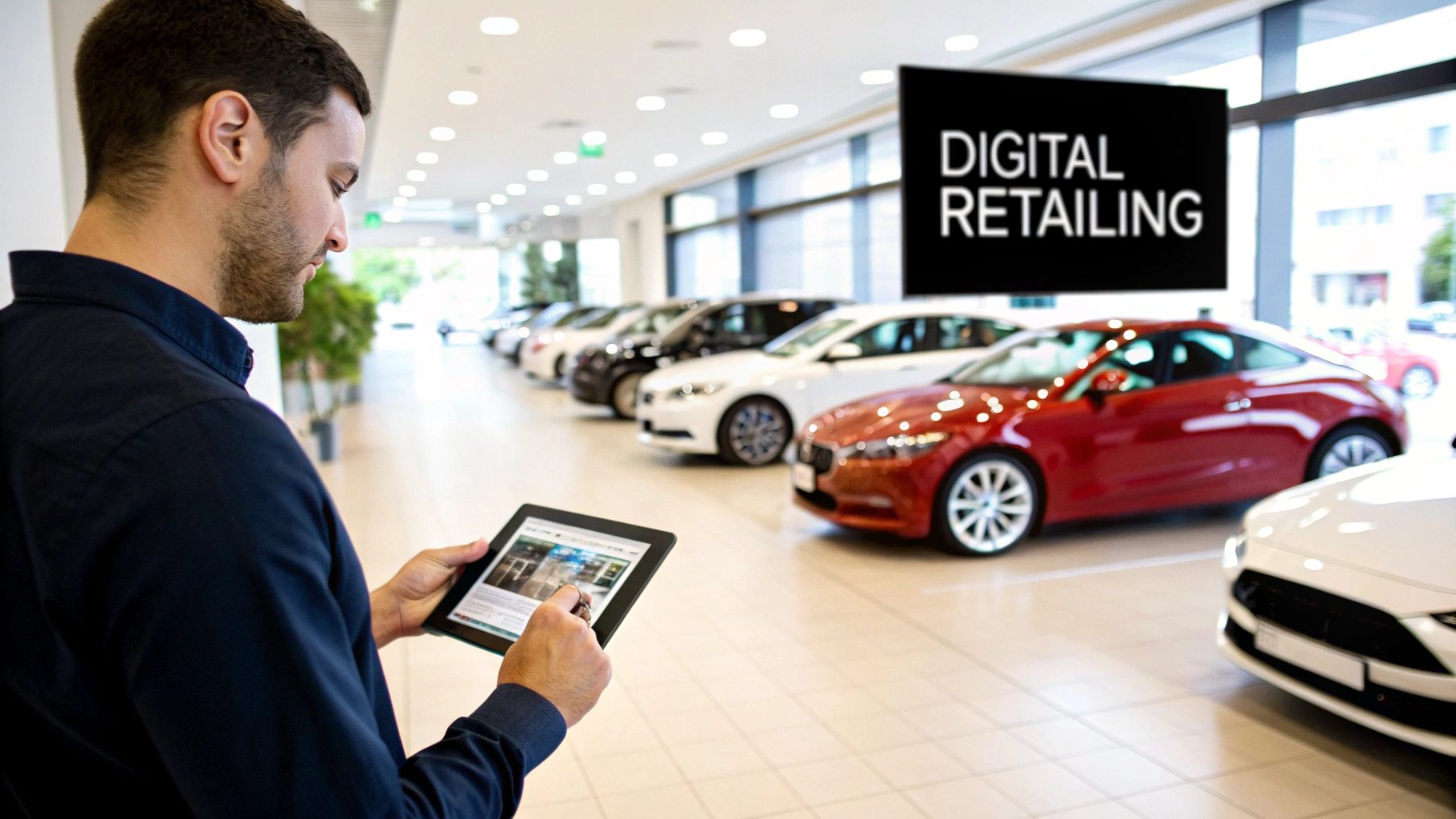
The whole narrative that digital tools will make showrooms obsolete completely misses the mark. Today’s car buyer doesn’t want a 100% online transaction any more than they want a 100% in-person one. They want a blended experience that respects their time. That’s the entire game plan behind a winning digital retailing automotive strategy.
It’s not about forcing people down some rigid online funnel. It’s about creating a seamless flow. A buyer can start on your website, play with payment options, and get a real trade-in estimate. Then, they can walk into your dealership for a test drive without feeling like they have to start the entire process over from square one.
Redefining the Customer Journey
Let’s be honest, the old model of hoarding information until a customer is physically in the showroom is dead. Buyers today show up armed with research and they expect transparency from the get-go. A solid digital platform gives them just that, building trust long before they ever step through your doors.
This isn’t just a fleeting trend; it’s a massive shift in the market. The automotive digital retailing software market is booming, proving just how widespread this change is. Valued at an estimated $1.5 billion in 2025, it’s projected to explode at a compound annual growth rate of 15%, potentially hitting $5 billion by 2033. You can dig into the market growth data yourself over at datainsightsmarket.com. These numbers make it crystal clear: investing in these tools is no longer a choice if you want to stay in the game.
The goal of digital retailing isn’t to eliminate the salesperson. It’s to empower them. When tedious paperwork and initial negotiations are handled online, your team can focus on what truly matters: building relationships and providing expert advice.
When you’re looking for a digital retailing platform, it’s easy to get lost in a sea of features. To cut through the noise, we’ve broken down the absolute must-haves that will deliver a top-tier experience for your customers and a real competitive advantage for your dealership.
Essential Features for a Modern Digital Retailing Platform
| Feature | Consumer Benefit | Dealership Advantage |
|---|---|---|
| Accurate Trade-In Valuation | Provides a transparent, instant, and fair trade-in offer, building trust from the start. | Generates high-quality, local trade-in leads and streamlines the appraisal process. |
| Dynamic Payment Calculator | Allows customers to structure their own deal by adjusting term, down payment, and APR. | Delivers more qualified, sales-ready leads with realistic payment expectations. |
| Online Credit Application | Offers a secure and convenient way to apply for financing from home, saving time at the dealership. | Speeds up the F&I process, reduces in-store wait times, and improves deal efficiency. |
| F&I Product Menus | Lets buyers explore and select protection plans in a low-pressure environment. | Increases F&I product penetration and boosts per-vehicle revenue (PVR). |
| Online Appointment Scheduling | Empowers customers to book test drives or final paperwork appointments on their schedule. | Improves show rates, optimizes staff scheduling, and creates a smoother in-store workflow. |
Having these core components in place ensures your platform isn’t just a glorified lead form but a powerful tool that moves the needle on both customer satisfaction and your bottom line.
Key Benefits of a Blended Approach
When you properly integrate these online tools with your physical store, you create a powerful synergy that benefits everyone involved.
Here’s where you’ll see the real impact:
- Increased Efficiency: Deals that begin online almost always close faster in the store. This slashes the time per transaction, freeing up your team to handle more customers.
- Improved Customer Satisfaction: When you give buyers control over the pace and process, they have a more positive, less stressful experience. That directly translates to better CSI scores and more repeat business.
- Higher Gross Profit: Customers who browse F&I menus online, without a salesperson looking over their shoulder, are often more inclined to purchase additional products. This is a simple way to boost your per-vehicle revenue.
At the end of the day, the dealership isn’t going anywhere—it’s just getting a massive upgrade.
Building Your Dealership’s Digital Foundation
Choosing the right technology for your dealership isn’t just about picking a software vendor. It’s about building an entire ecosystem that delivers a smooth, seamless experience for your customers from start to finish. Think of this digital foundation as the engine powering your entire digital retailing strategy—getting it right from the jump is non-negotiable. It’s the framework that has to support everything, from that first online click to the final handshake in the showroom.
The first big fork in the road is deciding between an “all-in-one” suite versus a “best-of-breed” approach. An all-in-one platform gives you a single, cohesive system from one provider. This usually makes training easier and ensures every module, from your inventory to F&I, is built to work together without any friction.
On the flip side, a best-of-breed strategy is like building a custom toolkit. You pick and choose specialized tools from different vendors for each job—maybe the top-rated trade-in tool, a separate F&I menu provider, and another for credit apps. This gives you a ton of flexibility and lets you use the best tool for every specific task, but it requires serious planning to make sure all the pieces talk to each other correctly.
Preventing Digital Disconnects
No matter which path you take, seamless integration is everything. Your new digital retailing tools have to communicate perfectly with your existing Dealer Management System (DMS) and Customer Relationship Management (CRM) software. If they don’t, you’re just creating isolated islands of data, and that’s a recipe for disaster.
Picture this: a customer fills out a credit application on your website, but that critical information never makes it into your CRM. Now your sales team is flying blind, forced to ask the customer to repeat information they’ve already handed over. It’s a frustrating, disjointed experience that completely undermines the point of investing in digital tools in the first place.
A truly integrated system means a deal started on a customer’s phone can be instantly pulled up and moved forward by your team in the showroom. That smooth handoff is the secret sauce to building trust and dramatically cutting down transaction times.
The Non-Negotiable Digital Assets
Beyond the core platform, some digital assets are no longer nice-to-haves; they are the absolute baseline for what today’s car buyers expect. These are the tools that replicate the tangible, sensory experience of being on the lot, but in a digital format.
- High-Resolution Photography and Videography: Grainy, low-quality photos are a complete deal-breaker. You have to invest in professional, high-resolution images that show every angle of the vehicle, inside and out. Walkaround videos are even better, offering a dynamic view that static photos just can’t match.
- 360-Degree Virtual Tours: Let your customers digitally “sit” inside the car. Interactive 360-degree views of the interior and exterior give them the freedom to explore every feature and get a real feel for the vehicle right from their couch.
- User-Friendly Digital F&I Menus: Putting your F&I products online in a transparent, low-pressure format is a massive win. Customers can educate themselves on options like service contracts and GAP protection at their own pace. We’ve seen this lead to higher product penetration and a solid boost in per-vehicle revenue time and time again.
The infographic below shows how these digital assets all fit together in a modern, customer-first car buying process.
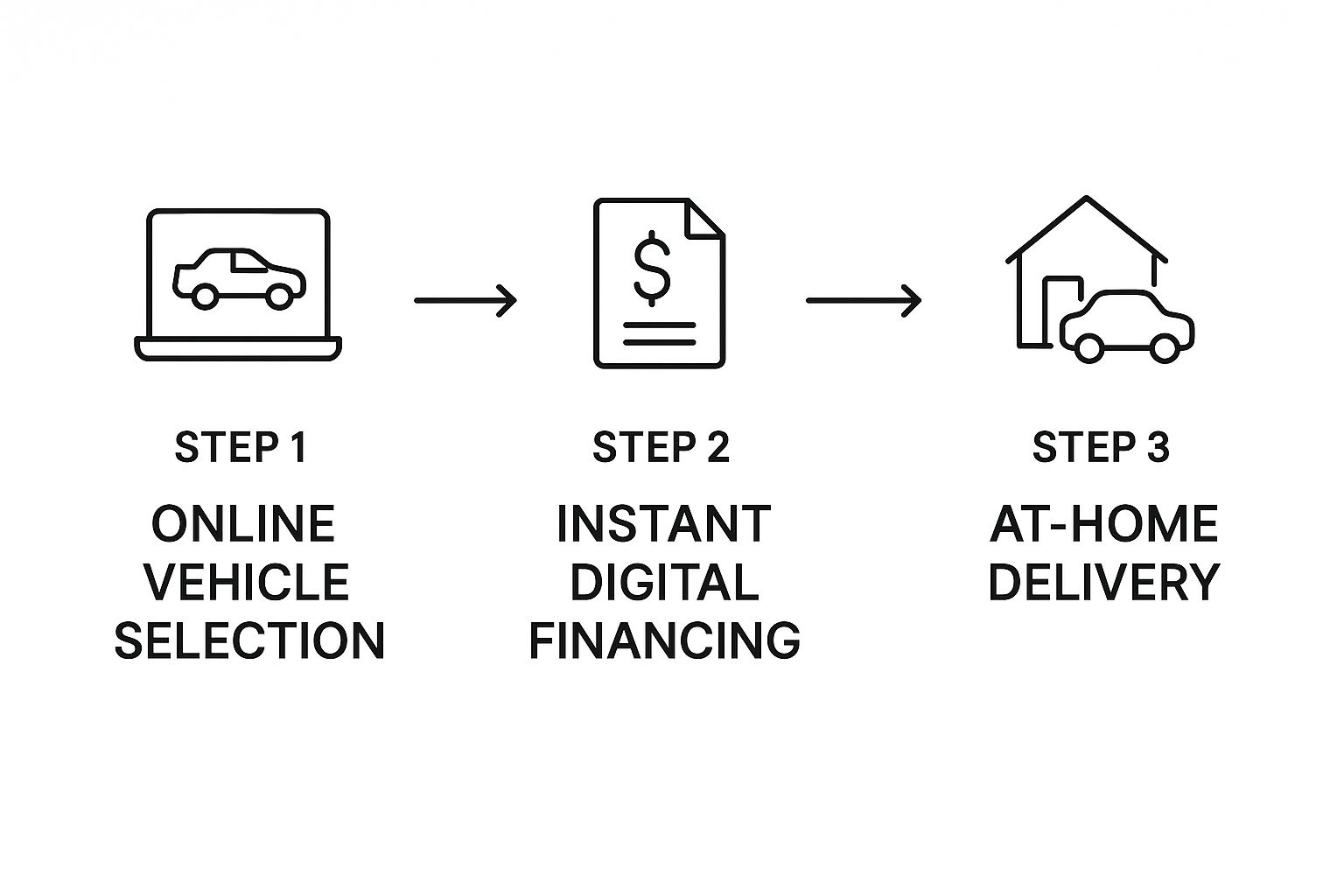
This visual breaks down a cleaner path to purchase, where technology empowers the customer to move from vehicle selection to financing to final delivery with as little friction as possible. But remember, building a powerful digital presence is just one piece of the puzzle. You also have to drive the right kind of traffic to these amazing new tools.
Connecting the Online and In-Store Experience

Here’s where most digital retailing automotive strategies fall flat: the disconnect between what a customer does online and what happens when they walk through your doors.
Think about it. A customer spends an hour on your website, carefully picking a vehicle, valuing their trade, and dialing in their payments. They’re invested. Then they arrive at your store, excited to move forward, only to be hit with, “So, what brings you in today?”
That one question completely invalidates all the work they just did. It’s a moment of friction that can instantly break the trust you were building. The entire goal of digital retailing is to create a seamless, continuous experience—where a deal started on a phone is effortlessly pulled up on a tablet in your showroom.
This kind of smooth handoff requires a real strategy that blends your tech with your team’s day-to-day process. It’s about making the leap from the screen to the showroom feel like one uninterrupted conversation.
Training Tech-Empowered Consultants
Your sales team isn’t being replaced by this technology; they’re being supercharged by it. The first step is to get them to see themselves less as traditional salespeople and more as tech-empowered consultants. This means getting them properly trained on the digital retailing platform so they can use it as a live deal-management tool, not just another lead source.
They need to be pros at:
- Accessing customer data: They should be able to instantly find a customer’s profile, see the exact car they built, view their trade-in details, and look at the payment structures they saved.
- Continuing the conversation: This is key. Acknowledge the work the customer put in online and pick up right where they left off.
- Using the tool collaboratively: The best consultants sit down next to the customer with a tablet, making real-time adjustments to the deal together. It reinforces their role as a helpful guide.
When a customer walks in and your consultant says, “Hi Jessica, I see you’ve already structured a great deal on the blue Highlander. Let’s pull that up and get the keys for your test drive,” you’ve created a ‘wow’ moment that builds instant rapport.
Managing Appointments from the Digital World
Appointments booked online are a different breed from your typical walk-in. These customers are highly qualified, have already invested their own time, and are walking in with the expectation of a quick, ready-to-go experience. Your workflow has to reflect that.
A recent Cox Automotive study confirms this shift, pointing out that the number of dealers offering every single car-buying step online has doubled in just two years. The same study found that buyers who interacted with AI chatbots reported a 57% improvement in their dealership experience. This just shows how powerful properly integrated tech can be. You can discover more insights on the digitization of automotive retail here.
For your BDC and sales teams, this means having a rock-solid process for confirming appointments, having the vehicle pulled up and ready, and getting all the customer’s digital paperwork queued up before they arrive. Nothing tells a customer “we value your time” quite like being fully prepared for their visit.
By the way, social media is a fantastic way to drive these high-intent shoppers to your digital platform in the first place, filling up that appointment calendar. Our guide on effective automotive social media marketing has practical tips you can use to make that happen.
When you successfully bridge that gap between online convenience and in-person expertise, you turn a simple transaction into a personalized journey. You’ll not only speed up the sale but also build a customer for life.
Getting High-Intent Traffic to Your Digital Showroom
Your new digital retailing automotive platform is a serious piece of machinery, but without the right fuel, it’s just an expensive decoration. To get real results, you have to shift your entire marketing mindset. The goal isn’t just grabbing a name and a phone number anymore; it’s about pulling in-market buyers to a place where they can start the deal on their own terms.
This means you’ve got to move past those generic, brand-level ads and get surgical. You need to fill your funnel with shoppers who are actively hunting for the exact vehicles sitting on your lot. When your ads and your digital tools are in sync, you attract customers who aren’t just browsing—they’re ready to make a move.
Target In-Market Buyers with Precision
Look, your dealership’s most valuable asset is the first-party data sitting right in your CRM. Your past sales, service records, and old leads are an absolute goldmine for building hyper-targeted audiences for your ad campaigns on platforms like Google and Facebook.
For example, pull a list of customers who bought a specific model three or four years ago and are probably nearing the end of their loan. Now, hit them with ads for the brand-new version of that exact same model. You’re reaching out to a proven audience with a high probability of being back in the market. It just makes sense.
Your ad copy needs to scream convenience. Ditch the generic “Click Here for Our Best Price” and start using action-oriented language like “Structure Your Deal From Home” or “Get Your Real Trade-In Value Instantly.” You’re speaking directly to the modern car buyer who craves control and efficiency.
Master VDP-Level Retargeting
One of the most powerful plays in your book should be Vehicle Detail Page (VDP) retargeting. When a shopper lands on the VDP for a specific 2024 Ford F-150, they’re basically raising their hand and telling you what they want.
By setting up dynamic retargeting ads, you can show them that exact F-150 again while they’re scrolling through social media or reading the news. This keeps your truck top-of-mind and nudges them back to your site to finish what they started. It’s a direct line to a high-intent customer who’s already narrowed down their search.
Local Search Is Your Best Friend
Never, ever underestimate the power of local search. People aren’t just searching for “cars”; they’re typing “Toyota dealer near me” or “used SUVs in Dallas” into their phones every single day. If your dealership isn’t optimized for these local searches, you’re invisible to the customers closest to you.
To really grab the attention of local car buyers, you need to nail your local SEO. Implementing a few proven 9 Best Local SEO Strategies to Dominate Your Market can make a world of difference. When you have a strong local presence, you ensure that when a nearby customer is ready to buy, your dealership is the first one they find.
When you bring all these pieces together—your own data, sharp retargeting, and a rock-solid local presence—your marketing transforms from a wide net into a series of powerful magnets. For a deeper dive, our guide on automotive lead generation offers more tactics to fill your pipeline. You’ll start attracting customers who are not just aware of your brand but are actively engaging with your inventory and ready to take the next step.
Measuring What Matters for Digital Retailing ROI
Let’s be blunt: clicks and impressions are vanity metrics. They might pump up a monthly report, but they don’t tell you if your digital retailing automotive strategy is actually putting money in the bank. If you want to prove the value of this investment, you have to track the KPIs that directly fatten your bottom line.
This is about shifting your focus from fuzzy, top-level data to real business outcomes. It’s the only way to see your digital platform as a profit-driver, not just another expense line item. We need to connect the dots between what a customer does online and what happens in the store.
Moving Beyond Clicks to Conversions
First thing’s first: we have to redefine what a “conversion” even means for a modern dealership. It’s not just a form submission anymore. We’re talking about tracking meaningful actions that show a customer is seriously moving down the road to a purchase.
We need to see how many shoppers are completing the high-value steps in your digital showroom. These are the numbers that tell a real story.
- Percentage of Sales Initiated Online: This is your north star. It tells you exactly how much of your sales pipeline is starting through your digital tools, proving people are actually using them.
- Completed Credit Applications: This is a massive buying signal. When someone fills out a credit app, they are no longer just browsing—they’re a highly qualified, serious buyer.
- Trade-In Valuations Submitted: Every completed trade-in form is a hot lead for both your new and used car departments. It’s an immediate opportunity.
By focusing on these concrete actions, you start to build a clear picture of how your digital tools are generating real sales opportunities, not just website traffic.
Measuring Efficiency and Profitability Gains
A winning digital strategy doesn’t just bring in more leads; it makes your whole operation leaner and more profitable. The real ROI is often found in the time you save and the extra value you capture in each deal. To really dial this in, it’s critical to learn how to measure advertising effectiveness and connect it to your operations.
Think about it. Customer behavior is shaped by your digital tools. We’ve seen firsthand how a smooth, connected experience pays off. The data backs it up, too. One study showed that customers using a dealership’s branded app are 73% more likely to buy a car from that dealer and schedule 25% more service appointments.
To see these gains in your own reports, start tracking these metrics:
- Average Time to Complete a Transaction: Measure the clock from the first online touchpoint to the moment they drive off the lot. A shorter sales cycle means your team can handle more volume, period.
- F&I Product Penetration Rate: Compare the F&I PVR for deals that started online versus your traditional walk-ins. You’ll often find the low-pressure online environment leads to a higher uptake on warranties and other products.
Getting a handle on these numbers is non-negotiable. For a complete walkthrough on tying every dollar you spend back to a tangible result, check out our guide on https://willowoodventures.com/marketing-roi-measurement/.
Comparing Performance With a Digital Retailing Strategy
The difference between a traditional process and a modern, digital-first approach is night and day. This table shows the kind of shift you can expect in key metrics once you have a fully integrated digital retailing process humming along.
| Performance Metric | Traditional Dealership | Digital-First Dealership |
|---|---|---|
| Average Sales Cycle | 5-7 days | 1-2 days |
| F&I PVR (Per Vehicle Retail) | $1,200 | $1,550+ |
| Online Credit App Submissions | < 10% | > 40% |
| Sales Staff Time Per Deal | 4-6 hours | 1-2 hours |
| CSI (Customer Satisfaction Index) | 85-90% | 95%+ |
As you can see, the improvements go far beyond just lead generation. We’re talking about fundamental gains in efficiency, profitability per unit, and customer happiness—the core pillars of a healthy dealership.
Answering Your Digital Retailing Questions
Switching up how you sell cars is a big move, and it always comes with questions. When dealers start looking at digital retailing, a few common worries always pop up—cost, staffing, and how the day-to-day stuff actually works.
Let’s cut through the noise and tackle the big questions we hear from dealers just like you every single day. Getting clear answers is the first step to moving forward with confidence.
How Much Should I Budget for a Solution?
Honestly, the costs for digital retailing tools are all over the map. You could find a simple payment calculator plugin for a few hundred bucks a month, or you could invest in a fully loaded platform with digital F&I, e-signing, and deep DMS integration that runs into the thousands.
But getting hung up on the monthly fee is the wrong way to look at it. The real question is about the potential ROI. A solid digital retailing platform should more than pay for itself by making your team more efficient, bumping up the gross on every deal, and lifting your overall sales volume.
The right digital retailing tool isn’t a cost center; it’s a profit-generating engine. Focus on how it can reduce your time-per-sale and increase PVR, and the investment will make perfect sense.
Will These Tools Make My Sales Team Obsolete?
Absolutely not. This might be the biggest myth out there about digital retailing. These tools don’t replace your sales professionals; they make them better.
Think about it: by automating the tedious, back-and-forth parts of the deal, you free up your people to do what they do best. They can focus on building real relationships, being true product experts, and delivering an experience that makes customers want to come back.
Their role shifts from being a gatekeeper of information to a trusted guide. With the right training, your team will use these platforms to manage more deals in less time and close more customers, not stand in the unemployment line. In fact, sharpening your team’s skills is more crucial than ever. You can learn more about getting your staff ready through specialized automotive BDC training that’s built for a modern, tech-driven sales process.
How Do Trade-Ins and Test Drives Work?
They don’t go away—they just get a whole lot smarter and more efficient. It becomes a much better experience for the customer and your team.
Trade-Ins: A customer can get an instant, reliable value for their trade online using trusted tools like KBB. That number is then quickly confirmed with a quick walkaround when they get to the store. This makes the whole process transparent and gets rid of the friction.
Test Drives: Shoppers schedule their test drive online, but here’s the key—they do it after they’ve already started working their deal. This means your team is only spending time with highly-qualified, serious buyers who are ready to move forward. The entire workflow just becomes more productive for everyone.
At Willowood Ventures, we specialize in driving high-intent buyers directly to your digital and physical showroom. Our Facebook Sales Event strategy is designed to generate hundreds of qualified appointments, seamlessly integrating with your new digital retailing process to turn online interest into closed deals. Find out how we can boost your ROI at https://www.willowoodventures.com.