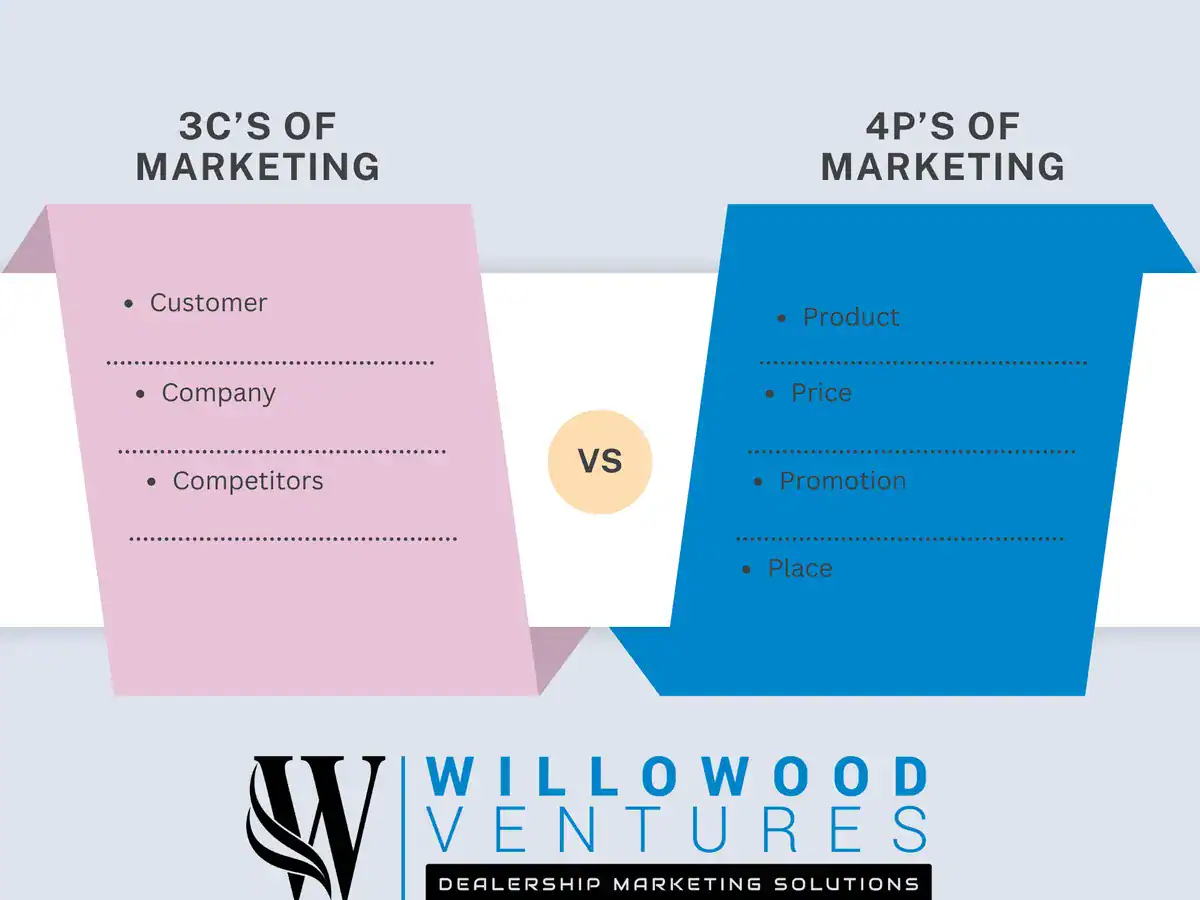
The 4Ps of Marketing have been the backbone of every solid go-to-market plan for decades. But the dealers moving metal right now aren’t just running a product-price-place-promotion checklist. They’re layering in personalization, and the results are measurable, repeatable, and frankly hard to argue with.
The 4Ps of Marketing Still Matter. Here’s What Changed.
Product. Price. Place. Promotion. Any dealer who’s sat through a 20-group meeting has heard these four words. The framework is solid. It gives your team a structure for making decisions without reinventing the wheel every quarter. The problem isn’t the 4Ps themselves. The problem is treating them like they exist in a vacuum, separate from the actual human beings you’re trying to sell a car to.
Modern automotive marketing builds on that foundation. The dealers consistently hitting their numbers aren’t abandoning the 4Ps. They’re extending them with People, Personalization, and Privacy, and they’re using data to make every touchpoint feel relevant instead of random.
Pricing Strategy: Skimming vs. Market-Fit Pricing in Automotive
Market skimming, setting a high initial price and stepping it down over time, works for Apple. It works for luxury trim launches. It works when you have genuine exclusivity and a customer base that will pay a premium to be first. That’s a real scenario in automotive, particularly with limited allocation vehicles or new EV models hitting the lot before the competition has inventory.
But skimming has a shelf life. The moment a competitor prices aggressively or inventory loosens up, that premium position evaporates. Smart pricing strategy means knowing when to hold the line and when to move. Holding gross on a unit nobody’s test driving isn’t a strategy. It’s a staring contest with the clock.
The practical application Car Salesman Commission Structures Explained is tying your pricing decisions directly to your promotional calendar. A well-executed Facebook Sales Event, for example, creates urgency that justifies price positioning in the customer’s mind. It’s not just about what you charge. It’s about the context you build around the price.
Service Marketing: Applying the 4Ps to an Intangible Sale
Selling a service is harder than selling a vehicle. Customers can’t kick the tires on an oil change package or a service contract. That’s why the 4Ps framework gets a workout in the service drive, and why the dealers who apply it deliberately tend to hold stronger customer pay numbers.
Product: Define what your service department actually offers, not just the line items on a menu, but the experience, the guarantee, the loaner car policy.
Price: Be transparent. Customers who feel surprised by a bill don’t come back. Customers who feel they got fair value do.
Place: Is your service lane easy to pull into? Is your online scheduling tool functional or frustrating? The physical and digital entry points both count.
Promotion: Service retention is a marketing problem. Email campaigns, service reminders, and targeted social ads to your existing customer base all move the needle.
Layer in referral programs, customer testimonials on your website, and niche authority content, like a video series on what to watch for when buying used, and you start building the kind of trust that turns a one-time buyer into a repeat customer.
Personalization Is Not Optional Anymore
Personalization used to be a differentiator. Now it’s the baseline expectation. Customers have been trained by Amazon, Netflix, and their own social feeds to expect content that’s relevant to them specifically. When your dealership sends a conquest mailer for a full-size truck to a customer who just bought a compact crossover, you haven’t just wasted the print cost. You’ve signaled that you don’t know them.
The good news is that personalization at scale is completely achievable when you have the right data infrastructure and the right marketing partner running it. Willowood Ventures manages over $4 million per month in social advertising managed across its dealer client base, and a large portion of that effectiveness comes from audience segmentation, matching the right message to the right customer at the right moment in their buying cycle.
Done correctly, personalization drives higher conversion rates, builds loyalty faster, and gives your team better intelligence about what your market actually wants. A customer who receives a targeted offer on the exact vehicle segment they’ve been researching is not just more likely to click. They’re more likely to show up, and more likely to buy.
People and Privacy: The Two Ps That Dealers Underestimate
People, meaning your own team, are a marketing asset that most dealerships underutilize. Your BDC rep who handles a lead with speed and empathy is doing marketing. Your service advisor who explains a repair clearly and honestly is doing marketing. The 4Ps framework only delivers if the people executing it are trained, supported, and working a consistent process.
Willowood’s US-based BDC operates 24/7, and that availability matters. Leads don’t care what time it is when they decide to research a car. A 72% appointment show rate doesn’t happen by accident. It happens because real people are following up with urgency, handling objections in real time, and confirming appointments like they mean it.
Privacy is the other underestimated P. Customers are more aware of their data rights than ever. A dealership that communicates clearly about how it uses customer data, and that actually respects opt-outs and preferences, builds trust faster than one that fires off blast emails to every address in the CRM. Privacy compliance isn’t just a legal checkbox. It’s a signal to customers that you take the relationship seriously.
Putting It Together: A Practical Framework for 2025
Here’s how the evolved 4Ps translate into a working marketing plan for a dealership today.
Product: Know your inventory, your upsell opportunities, and what each vehicle segment means to each customer profile.
Price: Set price strategy based on competitive data and promotional timing, not habit.
Place: Your website, your social channels, your lot, and your service drive are all placements. Each one should be consistent with your brand.
Promotion: Use targeted digital advertising with real audience segmentation. Broad reach is less valuable than relevant reach.
People: Train your BDC and floor staff to treat every touchpoint as a brand moment.
Personalization: Segment your audiences. Match offers to behaviors. Measure what converts.
Privacy: Communicate clearly, honor preferences, and build a reputation for doing right by customer data.
Dealerships that run this full framework consistently don’t just hit a good month. They build pipelines. Willowood clients average a 90% client rebook rate, and that’s because the system works across the full customer lifecycle, not just at the top of the funnel.
The 4Ps gave us the vocabulary. Personalization gives us the precision. Run both, and you’ve got something worth selling.
Ready to put a real strategy behind your marketing? Call Willowood Ventures at 843-310-4108 or explore our Facebook Sales Events to see how we build campaigns that actually move vehicles.
Make Willowood Ventures a preferred source on Google
One tap tells Google you want our dealership marketing coverage surfaced first. You will see Willowood Ventures more often in Top Stories, AI Overviews, and AI Mode when you search anything about selling more cars. It is free, it takes a second, and it brings you right back to this page.
What is automotive marketing strategy and why is it important for car dealerships? +
An automotive marketing strategy is the deliberate plan a dealership uses to attract, engage, and convert car buyers across every channel, from social ads and email to the service drive and BDC calls. It connects your inventory, pricing, promotions, and people into a system that works together instead of in silos.
Without a defined strategy, dealerships tend to react to slow months with random discounts and blast emails that erode margin without building long-term pipeline. A real strategy gives your team a framework to execute consistently.
Willowood Ventures works with 600+ dealer partners across the country and has managed over $4 million per month in social advertising managed. That scale means we’ve seen what works in virtually every market type and can build a strategy around your specific inventory mix and customer base.
How does personalization benefit dealerships using an automotive marketing strategy? +
Personalization means delivering the right message to the right customer at the right time, based on actual behavior and data rather than assumptions. For a dealership, that could be a retargeting ad showing a customer the specific truck trim they spent 8 minutes looking at on your VDP, or a service reminder timed to their specific mileage interval.
The practical benefit is higher conversion. When a customer sees an offer that feels relevant to their situation, they’re more likely to click, call, or show up. Generic broadcast advertising still has a place, but personalized follow-up is what closes the gap between interest and appointment.
Willowood’s approach to audience segmentation and personalized follow-up consistently delivers a 72% appointment show rate for our dealer clients. That number reflects what happens when messaging is targeted and follow-up is timely and specific.
What are the key components of a successful automotive marketing strategy? +
A successful automotive marketing strategy runs on seven elements working together. First, clear inventory positioning so customers understand what you have and why it’s the right choice for them. Second, data-driven audience segmentation so your ads reach people actually in market. Third, a strong digital presence including a fast website with functional VDPs and easy lead capture. Fourth, consistent BDC follow-up that handles inbound leads with speed and structured process. Fifth, a promotional calendar that creates real urgency tied to inventory needs. Sixth, service retention marketing that keeps sold customers coming back. Seventh, reporting and accountability so you know what’s working and can double down on it.
Missing even one of these creates a leak in the funnel. Willowood Ventures builds strategies that cover all seven, which is why our clients see consistent results across both sales and fixed ops.
How long does it take to see results from an automotive marketing strategy? +
For campaign-driven tactics like Facebook Sales Events, results are visible within the first weekend. Willowood has delivered events where dealers closed 64 units for $294,821 in gross revenue at a single Little Rock Volkswagen store. That’s not a months-long runway. That’s a focused campaign with the right audience, the right message, and BDC coverage to handle the inbound volume.
Longer-term strategies like organic search authority, service retention campaigns, and reputation building take 90 to 180 days to show meaningful compounding returns. The smart play is running both in parallel: short-cycle campaigns to hit monthly targets, and longer-cycle investments to reduce your cost-per-sale over time.
Most dealers working with Willowood see enough ROI in the first campaign to justify the full-year commitment without question.
What kind of ROI can dealerships expect from professional automotive marketing strategy? +
Willowood Ventures clients average an 800% return on investment across our programs. That’s not a cherry-picked outlier. It’s a consistent pattern we see because our model combines targeted digital advertising, a 24/7 US-based BDC operation, and campaign execution refined across 600+ dealer partners.
To put real numbers behind it: a Salt Lake City GMC store ran one of our campaigns and moved 89 units for $421,593 in gross. An Oklahoma City CDJR store hit 83 units for $398,762. A Torrance Chevrolet store closed 72 units for $345,688. These are actual results from actual stores.
ROI varies by market, inventory mix, and how well the dealership’s internal team supports the campaign. But dealerships that bring their BDC and floor staff into the process consistently see the strongest returns.
How does automotive marketing strategy differ from traditional dealership methods? +
Traditional dealership marketing was largely broadcast-based. You bought TV spots, ran newspaper ads, and hoped the right buyers were watching or reading at the right time. The math was simple but the targeting was blunt. You paid for a lot of impressions that had zero relevance to your inventory.
Modern automotive marketing strategy flips that model. Instead of buying reach and hoping for relevance, you build audiences based on in-market signals, browsing behavior, and CRM data, then serve specific messages to people who are already in a buying mindset. The reach is smaller but the conversion rate is dramatically higher.
The other major difference is accountability. Traditional media rarely told you how many cars it sold. Digital-first strategies built around clear KPIs, set rates, show rates, and closing rates give you a direct line between spend and output.
What role does BDC follow-up and audience targeting play in automotive marketing strategy success? +
BDC follow-up is where most leads either convert or die. You can run a perfectly targeted ad campaign and generate 200 quality leads, but if your follow-up is slow, inconsistent, or handled by someone reading from a generic script, a large portion of those leads go cold before they ever walk the lot.
Willowood’s BDC operates 24/7, seven days a week. That 24/7 coverage window means we’re reaching leads when they’re actually available to talk, not just during business hours. Our set rate runs at 35%, with a 65% show rate for appointments set, and a 15% overall closing rate across campaigns.
Audience targeting determines which leads you generate. BDC follow-up determines how many of those leads become appointments. Both have to be strong. One without the other cuts your results in half.
How important is timing for launching an automotive marketing strategy? +
Timing matters more in automotive than most industries because buying cycles are predictable. Tax season, end of model year, holiday weekends, and manufacturer incentive windows all create natural demand spikes. A strategy that’s already in market when buyers start searching outperforms one that launches reactively after the spike has started.
For campaign-based events, timing is even more precise. A Facebook Sales Event needs 7 to 10 days of runway to build audience momentum before the event weekend. Launching on Monday for a Friday event doesn’t give the algorithm time to optimize.
For dealerships with seasonal inventory patterns, like truck country stores ahead of summer or EV-heavy markets ahead of tax credit deadlines, building a promotional calendar three months out instead of three weeks out compounds the results significantly.
What makes automotive marketing strategy more effective than alternative methods? +
The core advantage is precision. A well-built automotive marketing strategy matches specific inventory to specific buyers based on real data, rather than making educated guesses about who might be watching a particular TV channel at 7pm.
It’s also scalable and measurable in ways traditional advertising never was. You can test two ad creatives against the same audience, see which one generates more VDP visits, and shift budget within 24 hours. That kind of optimization loop is impossible with a billboard or a radio spot.
Finally, a real strategy compounds over time. Your CRM data gets richer. Your retargeting audiences get more refined. Your BDC team gets better at handling the specific objections your market raises. Alternative one-off methods reset to zero after each campaign. A strategy builds on itself, which is why Willowood’s clients carry a 90% rebook rate.
Why should dealerships choose Willowood Ventures for their automotive marketing strategy? +
Willowood Ventures is the premier choice for automotive marketing strategy because of our proven track record, our specific experience serving 600+ dealer partners, and the $4 million per month in social advertising managed we’ve managed on behalf of dealer clients across every major market type.
We don’t sell packages built on theory. Every tactic we recommend, from Meta-certified campaign execution to our 24/7 BDC coverage, has been stress-tested against real inventory goals at real stores. When a Torrance Chevrolet store closes 72 units for $345,688, that’s the system working exactly as designed.
Our packages start with demo-call pricing, which means the strategy is accessible whether you’re a single-point independent or a multi-rooftop group. We tailor the execution to your inventory mix, your market, and your internal team’s capacity so nothing falls through the cracks.
Contact us at 843-310-4108 to walk through what an automotive marketing strategy built around your specific goals would look like.