
3 Cs of Marketing: A Practical Guide for Car Dealers
Developed by Kenichi Ohmae, the 3 Cs model (Customer, Company, Competition) gives you a clear lens for building marketing strategies that win. Here's how to put it to work for your dealership.
Most marketing advice boils down to "run more ads" or "post on social media." That's not strategy. Strategy is knowing exactly who you're selling to, what makes you different, and where the gaps in your market actually are. The 3 Cs framework gives you that clarity.
At Willowood Ventures, we use this model every time we design a Facebook Sales Event or build out a dealership's marketing strategy. The dealers who take time to honestly answer the questions in each "C" are the ones who see 800%+ ROI from their campaigns. The ones who skip it? They're the ones still wondering why their last ad spend didn't move the needle.
Three Pillars, One Winning Strategy
Customer
Who are they, what do they want, and how do they make buying decisions? Everything starts here.
- Demographics and psychographics
- Pain points and desires
- Buying journey and triggers
- Where they spend time online
Company
A brutally honest look at what you're great at, where you fall short, and what only you can offer.
- Core strengths and capabilities
- Brand perception in market
- Resources and technology
- Unique value proposition
Competition
Know the battlefield. Not to copy, but to find the gaps everyone else is missing.
- Competitor strengths and weaknesses
- Market positioning and pricing
- Underserved niches
- Emerging threats and trends
Customer: Get Inside Their Head
Your customers aren't just "people who buy cars." They're individuals with specific anxieties about monthly payments, frustrations with the buying process, and expectations shaped by every other online shopping experience they've ever had. If you're still marketing to a generic "car buyer" persona from 2015, you're leaving money on the table.
The deeper you understand your customer, the easier everything else becomes. Your ad copy writes itself. Your BDC team knows exactly what to say on the phone. Your email campaigns hit inboxes with messages that feel personally relevant.
How to Actually Research Your Customers
- Mine your CRM for patterns in who buys, when, and why
- Survey recent buyers about their experience and decision-making process
- Monitor Facebook and social conversations for unfiltered opinions
- Analyze website behavior with heatmaps and session recordings
- Review service ticket logs for recurring frustrations
- Interview your top salespeople about what they hear on the floor


Company: Know What You're Working With
This is where ego gets dealers in trouble. Saying "we have the best customer service in the tri-state area" doesn't make it true, and it definitely isn't a strategy. You need to look at your operation with clear eyes.
What are you genuinely better at than the competition? Maybe it's your used car reconditioning process. Maybe it's a service department that actually calls customers back. Maybe it's financing options for subprime buyers that nobody else in your market offers. Whatever it is, that's the kernel of your competitive advantage.
Company Analysis That's Actually Useful
- Run a SWOT analysis with your management team (not just the GM)
- Review your marketing ROI data from the last 12 months
- Identify your top 3 capabilities that competitors can't easily replicate
- Assess your digital presence honestly (website speed, mobile experience, review ratings)
- Survey employees about what they think the dealership does best
- Compare your gross profit metrics to industry benchmarks
Competition: Know the Battlefield, Don't Copy It
Competitive analysis isn't about obsessing over what the dealer across town is doing. It's about understanding the landscape well enough to find your own lane. Some dealers spend all their energy matching competitor pricing, dollar for dollar, and they end up in a race to the bottom that nobody wins.
The smarter move? Find the gaps. Maybe every competitor in your market is running the same tired TV spots while ignoring social media. Maybe nobody's offering a legitimate buyback program. Maybe the conquest email space in your zip code is wide open. Those gaps are where you win.
Competitive Intelligence That Matters
- Mystery shop your top 5 competitors (online and in-person)
- Track competitor ad presence on Facebook, Google, and local media
- Monitor their Google and Yelp reviews for recurring complaints
- Compare inventory strategies and pricing across your market
- Identify which marketing channels competitors aren't using
- Watch for new entrants, especially Carvana/online-only players in your market

How to Integrate All 3 Cs Into One Strategy
The framework only works when all three elements inform each other. Here's the process we use with our dealership consulting clients.
Use research to pinpoint what your customers actually care about, not what you assume they care about.
Identify where your strengths align with customer needs. That intersection is your competitive sweet spot.
Study the market for unmet needs and underserved segments that your competitors are ignoring.
Build an offer that leverages your strengths to fill market gaps in a way only you can deliver.
Choose channels and messaging that reach your target customers where they actually spend time.
Make sure your sales floor, BDC, and service teams are all executing the same strategy.
Launch campaigns, track ROI metrics, and hold your team accountable to results.
The best strategies evolve. Reassess your 3 Cs quarterly and adjust based on real performance data.
How Apple Mastered the 3 Cs
You don't have to be a tech company to learn from Apple's playbook. The principles translate directly to any business, including dealerships.
Customer
Apple targets people who value design, simplicity, and premium experiences. They understand that their customers will pay more for a seamless ecosystem where everything just works together. They don't try to compete on price, because they know their customer doesn't make decisions that way.
Company
Their strengths in design, branding, and user experience are genuinely world-class, not just marketing claims. They invest heavily in R&D, maintain exceptional supply chain control, and build products that create switching costs through ecosystem lock-in.
Competition
Rather than competing head-to-head with Android on specs or price, Apple carved out a premium niche and owns it completely. They maintain higher margins than any competitor and leverage brand loyalty for repeat purchases. They zig while the industry zags.
Common 3 Cs Mistakes That Kill Strategies
The automotive market shifts constantly. Interest rates, inventory levels, and consumer sentiment can change in weeks. Treat your 3 Cs analysis as a living document.
Obsessing over competition while ignoring customer research is a recipe for becoming a "me too" brand. Balance all three or the framework falls apart.
Gathering data is important, but at some point you have to pull the trigger. Perfect information doesn't exist. Get 80% of the way there and execute.
Competitive intelligence should inform your strategy, not dictate it. If you're just doing what the dealer across town does, you have no strategy at all.
A brilliant strategy means nothing if your sales floor, BDC, and service department aren't all rowing in the same direction. Communicate the plan to every team member.
3 Cs of Marketing FAQ
The 3 Cs of marketing is a strategic framework created by Kenichi Ohmae that focuses on three core elements: Customer (understanding your target audience's needs and behaviors), Company (assessing your internal strengths, weaknesses, and unique capabilities), and Competition (analyzing the competitive landscape to find differentiation opportunities). When aligned properly, these three factors form the foundation of an effective marketing strategy.
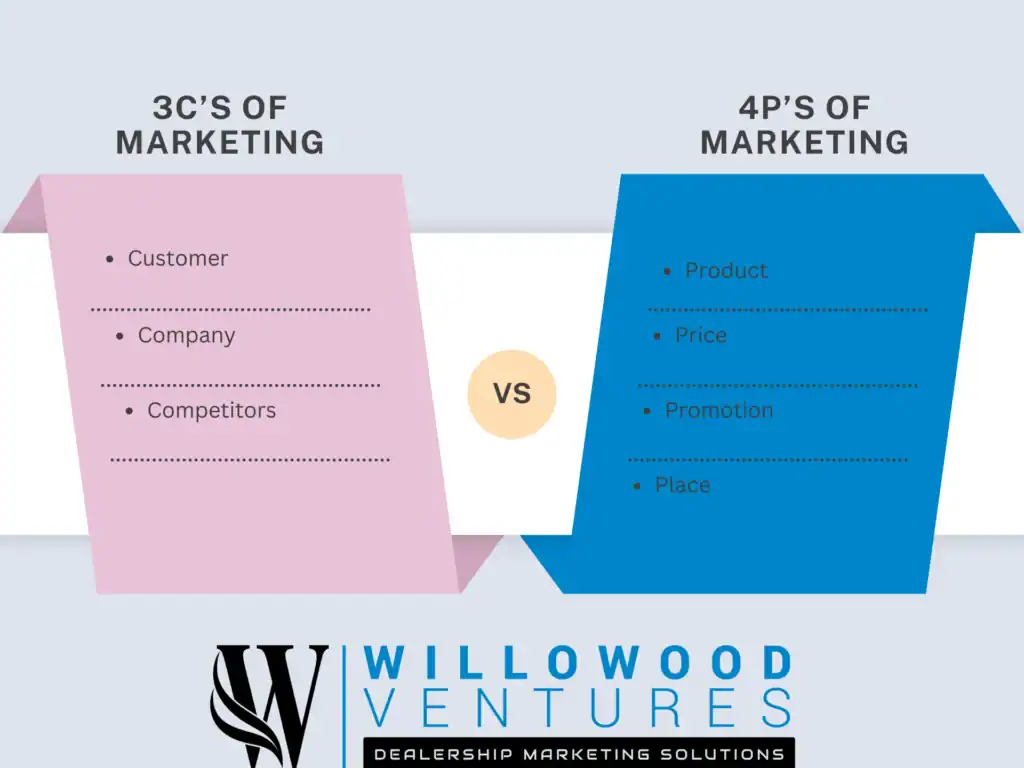
The 3 Cs framework is a strategic analysis tool that helps you understand the market environment before making decisions. The 4 Ps (Product, Price, Place, Promotion) is a tactical marketing mix framework for executing your strategy. Think of it this way: the 3 Cs tell you WHERE to compete and WHY, while the 4 Ps tell you HOW to compete. Most successful businesses use both, starting with the 3 Cs to inform their 4 Ps decisions.
Car dealerships can apply the 3 Cs by first understanding their customer's buying journey (most auto shoppers now research 12+ hours online before visiting a lot), then honestly assessing what makes their dealership different (inventory depth, service reputation, financing options), and finally studying what competing dealers within their market radius are doing with advertising, pricing, and customer experience. This analysis directly informs decisions about Facebook sales events, BDC strategy, email campaigns, and advertising spend.
While all three are essential and interconnected, the Customer is generally the most critical starting point. Without a deep understanding of who you're selling to and what they actually need, your company analysis and competitive positioning have no anchor. That said, overemphasizing any single C at the expense of the others leads to blind spots. The real power comes from the intersection of all three.
At minimum, conduct a thorough 3 Cs audit quarterly. Markets shift fast, especially in automotive where inventory levels, interest rates, and consumer sentiment can change month to month. Major industry events like new model launches, competitor openings or closings, or economic shifts should trigger an immediate reassessment. The most successful dealerships treat the 3 Cs as a living framework, not a one-time exercise.
For Customer research: surveys, CRM analytics, social media listening tools, Google Analytics, and direct customer interviews. For Company assessment: SWOT analysis, financial performance reviews, employee feedback, and core competency mapping. For Competition analysis: mystery shopping, social media monitoring, local ad tracking, market share data from sources like NADA, and tools like SEMrush for digital competitive intelligence.
Absolutely. The 3 Cs framework is especially powerful for digital marketing because digital channels generate measurable data for each C. Customer insights come from website analytics and social engagement. Company strengths can be tested through A/B testing and campaign performance. Competitive analysis includes tracking competitors' ad spend, keyword strategies, and social presence. At Willowood Ventures, we use the 3 Cs to design Facebook Sales Events that consistently outperform generic marketing approaches.
The most common mistake is analysis paralysis, spending months researching without taking action. The second biggest is focusing too heavily on competition and ending up as a copycat rather than a leader. Your 3 Cs analysis should inform a unique value proposition, not a carbon copy of what the dealer down the street is doing. Gather enough data to make a confident decision, then execute, measure, and iterate.
Ready to Build a Strategy That Actually Works?
Willowood Ventures helps dealerships across the country turn the 3 Cs into real results, with set appointments, proven ROI, and 24/7 BDC support.