

An automotive digital marketing agency is a specialized firm that gets the car business. They understand the unique chaos of selling cars online, from juggling live inventory feeds to crafting ad campaigns that target buyers just a few zip codes away. These agencies give dealerships an expert edge in SEO, PPC, and social media, all fine-tuned to attract and convert today’s car shoppers.
Why Generic Marketing Is a Dead End for Dealerships
Let’s be honest: marketing a car dealership isn’t like promoting a new restaurant or a local boutique. The customer journey is longer, the product is far more complex, and you’re fighting tooth and nail for every sale. Your competition isn’t just the dealership across town; it’s private sellers and massive online marketplaces, too.
A generic marketing agency, used to simpler, shorter sales cycles, almost always misses the critical details that actually drive automotive success. This disconnect burns through your ad budget, floods your CRM with irrelevant leads, and leaves a ton of money on the table.
Choosing the right marketing partner isn’t just another line-item expense. It’s a strategic investment in grabbing—and keeping—your local market share.
The Unique Hurdles of Selling Cars Today
Dealerships operate in a world of their own, with challenges a generalist agency just won’t be prepared for. This lack of experience leads to campaigns that are ineffective at best and damaging at worst.
Here are a few of the big ones:
- Complex Inventory Management: A dealership’s inventory is a living, breathing thing. It changes daily, even hourly. Your marketing must sync in real-time with what’s actually on the lot, a technical feat most generic agencies are completely unprepared to handle.
- Hyper-Local Competition: You aren’t just competing with dealers across the state. You’re in a dogfight for customers in your immediate service area. Your marketing has to be intensely local, targeting specific neighborhoods for both new car sales and fixed ops promotions.
- Intricate Sales Cycles: The road from a late-night Google search to a showroom visit can take weeks or months. A winning strategy means nurturing leads across dozens of touchpoints, from views on a Vehicle Detail Page (VDP) to that final test drive appointment.
- Strict Regulatory Compliance: Automotive advertising is tangled in a web of legal red tape and manufacturer co-op rules. An agency that doesn’t know the ins and outs of these regulations can accidentally put your dealership at serious risk.
The real issue is specialization. A generic agency might build you a slick-looking website. But an automotive specialist makes sure that website plugs directly into your CRM and inventory management system, turning clicks into actual appointments.
The Digital Shift Is Here to Stay
The move to online car shopping isn’t a passing trend; it’s a permanent change in how people buy cars. This shift has created a massive need for specialized marketing support.
The global automotive digital marketing market is expected to grow at a compound annual rate of about 12%. It’s projected to jump from roughly $15 billion in 2025 to a staggering $35 billion by 2033. You can explore the full market projections on automotive digital marketing to see just how big this is getting.
This explosive growth points to one simple truth: your competitors are already investing heavily in expert digital strategies. Without a specialized partner, you’re just shouting into the wind.
The right agency knows how to connect with today’s buyers—the ones who spend hours doing their homework online before they ever think about setting foot on your lot. They have the experience to turn a casual Facebook scroller into a scheduled test drive, making sure your dealership doesn’t just survive but actually thrives.
Setting Marketing Goals Your Dealership Can Actually Hit

Before you pick up the phone to call a single agency, you need to know your destination. Showing up to an agency interview with a vague request like “we need more leads” is like telling a taxi driver to “just drive.” You’ll burn through your budget and end up somewhere you never wanted to be.
To have a real, productive conversation, you first have to define what a “win” actually looks like for your store. This simple step is what separates a calculated, strategic decision from a shot in the dark. It ensures you and your future partner are on the same page from day one.
The whole point is to move past wishful thinking and lock in specific, measurable goals that directly fatten your bottom line.
From Vague Ideas to Concrete Targets
Instead of fuzzy goals, you need to think in terms of cold, hard numbers—your Key Performance Indicators (KPIs). When you start tracking the right key website metrics, the whole conversation changes from abstract wants to concrete results.
Let’s look at some real-world examples I’ve seen dealers use to get this right:
- Instead of: “more web traffic”
- Try: “Increase organic traffic to our Vehicle Detail Pages (VDPs) by 20% in the next six months.”
- Instead of: “better social media”
- Try: “Cut our cost-per-service appointment from Facebook ads by $15 over the next quarter.”
- Instead of: “we need more leads”
- Try: “Generate 50 qualified, credit-approved leads for new trucks each month through our paid search campaigns.”
See the difference? These goals are specific, measurable, achievable, relevant, and time-bound (SMART). They give you a clear yardstick to measure any agency’s performance against. You can find more strategies for defining these numbers in our guide on digital marketing for automotive dealers.
Setting clear, quantifiable goals is the most important step in this entire process. An agency can’t hit a target you haven’t defined. It’s your job to draw the bullseye; it’s their job to provide the arrows and the archer.
Conduct a Quick Internal Audit
Before you start outreach, take an honest look in the mirror at your current digital footprint. A quick audit will immediately highlight your weaknesses and most urgent needs. This doesn’t need to be some deep technical dive; a high-level review is all it takes.
Get your team together and ask these brutally honest questions:
- Where are our best leads coming from right now? Is it organic search, social, a third-party site, or just repeat customers? You have to know what’s working so you can double down on it.
- What’s our biggest weakness online? Is your website a slow, outdated dinosaur? Is your social media a ghost town? Are your online reviews a train wreck? No sugarcoating allowed here.
- How are we tracking anything today? Are you actually using Google Analytics? Do you have clean data in your CRM? Knowing what you can (and can’t) track is a huge piece of the puzzle.
- What have we tried before that completely bombed? Knowing what didn’t work saves you and your next agency from repeating expensive mistakes. Was that SEO push a total flop? Did that last direct mail campaign go straight into the trash?
Doing this quick check-up arms you with the right information. When you finally start talking to agencies, you won’t be asking them what they can do for you. You’ll be telling them exactly what you need, which leads to a partnership that actually works.
Looking Under The Hood: Evaluating An Agency’s Core Services
Not all “automotive marketing” is the same. I’ve seen countless generalist agencies slap an “automotive” label on their services, but when you look under the hood, it’s just repurposed templates from other industries. They don’t get it. Selling cars demands a unique set of tools and a deep understanding of the customer journey, from the first click to the showroom floor.
To see past a slick sales pitch, you have to dissect an agency’s actual service offerings. It’s not just about what they do, but how they do it specifically for dealerships like yours. This is where you separate the real experts from the pretenders.
This workflow shows the lifecycle of a real campaign—it’s not a one-and-done deal. It’s a constant cycle.
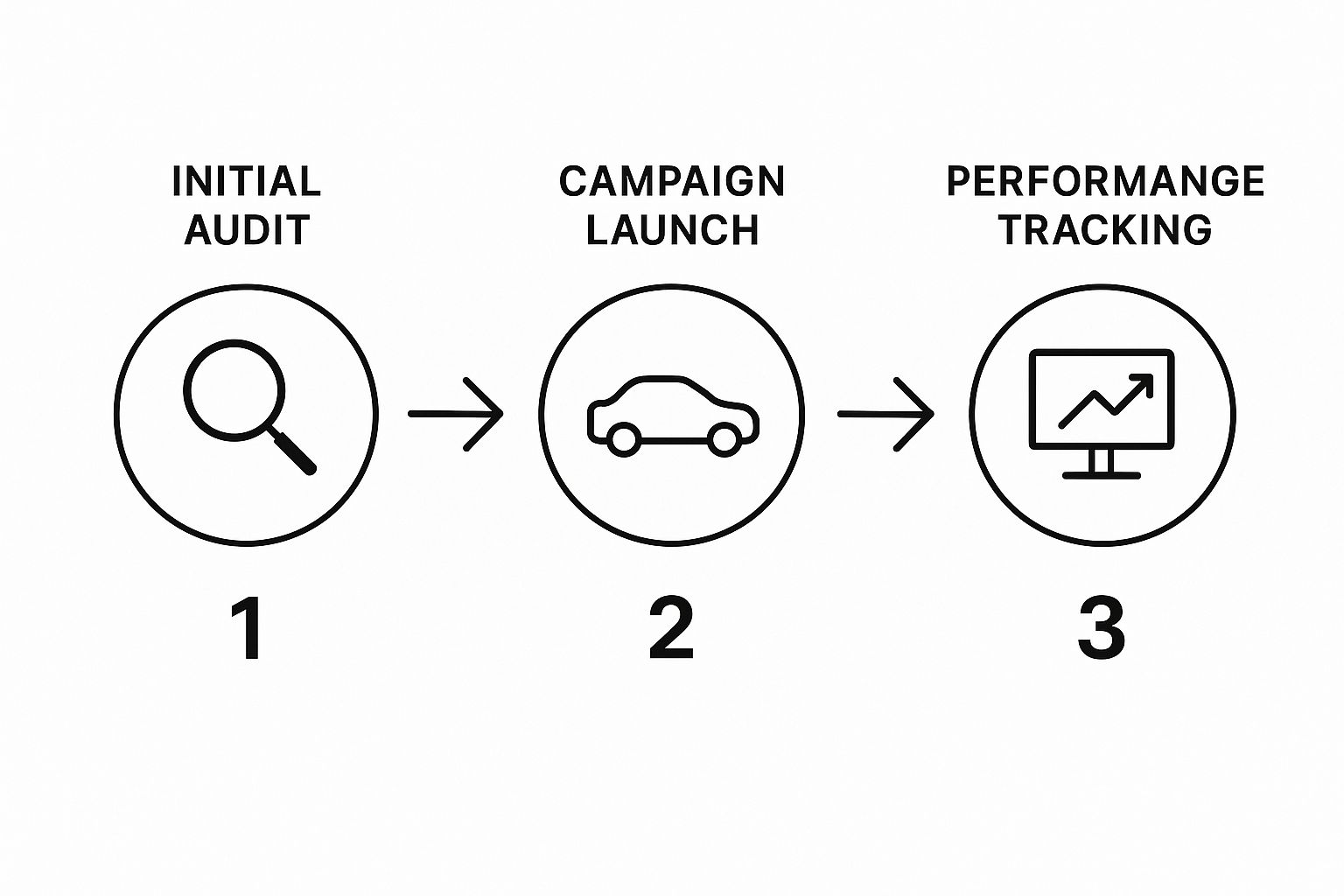
A successful partnership isn’t just about launching ads. It’s a continuous loop of auditing, executing, and refining based on what the data is telling you.
Automotive SEO That Actually Moves Metal
Generic SEO gets you clicks. Automotive SEO gets you appointments and showroom visits. The difference is huge. A top-tier agency isn’t chasing vanity traffic; they’re focused on strategies that drive bottom-of-the-funnel actions that lead to a sale.
They need to be fluent in:
- VDP Optimization: This is where the online sale really happens. Your Vehicle Detail Pages (VDPs) have to be packed with unique content, great photos, and the kind of structured data Google loves.
- Local Service Bay SEO: Your fixed ops department is a goldmine. A smart agency creates targeted content to make sure you rank #1 for searches like “Ford F-150 brake repair in [Your City].” That’s pure profit.
- Inventory Feed Syndication: This is a technical but non-negotiable service. Your inventory must be pushed accurately and instantly to your Google Business Profile, third-party sites, and everywhere else people are shopping.
Here’s a killer question to ask an agency: “Walk me through your process for ensuring our inventory feed syndicates correctly in real-time. What happens when there’s an error?” Their answer will tell you everything you need to know about their technical skills.
Precision-Targeted Automotive PPC
It’s way too easy to burn through a PPC budget. An expert automotive agency makes every single dollar count by using surgical precision in its campaigns. This goes way beyond just bidding on keywords like “used cars.”
Look for an agency that can show you examples of:
- Geo-Fenced Campaigns: Targeting shoppers who are physically within a few miles of your dealership—or even sitting on a competitor’s lot.
- Model-Specific Ad Groups: They should be crafting unique ads and landing pages for every single model you sell. Someone searching for an “Explorer” should see an ad for an Explorer, not a generic dealership ad.
- Aggressive Negative Keyword Management: This is crucial. They need to be actively blocking your ads from showing up for junk searches like “toy cars,” “junkyards,” or “car crash videos.”
A truly effective agency doesn’t stop at generating a lead. They have solid strategies for mastering lead nurturing automation, turning that initial click into a real conversation and, ultimately, a sale.
Social Media That Builds A Local Following
Any agency can post stock photos of cars on Facebook. A great partner builds a local community around your dealership. For a car dealer, social media is less about national brand awareness and more about local engagement and building trust.
Their strategy has to include:
- Showcasing Your Team: Put a human face on the dealership. Highlight your salespeople, your techs, and your involvement in local events.
- User-Generated Content: Get customers excited to share photos of their new cars and tag your dealership. That’s authentic social proof you can’t buy.
- Hyper-Local Ad Targeting: Running ads for service specials or new arrivals aimed directly at people in your specific zip codes.
Seamless CRM and DMS Integration
This is the technical backbone that makes everything else work. If an agency’s systems can’t “talk” to your CRM (like VinSolutions or DealerSocket) or DMS, you’re flying blind. Clean data integration is an absolute must.
You need a partner who can guarantee that every lead—whether it’s from a website form, a phone call, or a Facebook message—is automatically and accurately logged in your system. This is the only way to get proper attribution and know for sure which marketing efforts are actually driving sales. Ask them to walk you through their specific integration process for your software. A clear, confident answer is a huge green flag.
To help you keep everything straight, I’ve put together a checklist you can use when you’re comparing agencies side-by-side.
Core Automotive Marketing Services Checklist
This table is designed to be a practical tool. Use it during your meetings to directly compare what each agency offers and to make sure you’re asking the right questions.
| Service | What to Look For | Key Questions to Ask | Red Flags |
|---|---|---|---|
| Automotive SEO | VDP optimization, local service SEO, inventory feed management, and GMB optimization. | “Can you show me a VDP you’ve optimized that ranks on page one?” “How do you track service appointments generated from SEO?” | Vague answers about “increasing traffic.” No mention of fixed ops or inventory. |
| Automotive PPC | Geo-fencing, model-specific campaigns, negative keyword lists, and call tracking. | “What’s your strategy for targeting competitor locations?” “How do you measure cost-per-lead vs. cost-per-sale?” | Focus on impressions and clicks instead of conversions. Using broad, generic keywords. |
| Social Media | Community engagement, user-generated content, team showcases, and local ad targeting. | “Show me a campaign that generated real customer engagement, not just likes.” “How do you tie social media efforts back to website traffic or leads?” | Only posting inventory photos. Generic, corporate-sounding posts. No local focus. |
| CRM/DMS Integration | Direct experience with your specific platforms (e.g., VinSolutions, DealerSocket). Automated lead entry and source tracking. | “Describe your integration process for [Your CRM].” “How do you ensure 100% of leads are captured correctly?” | Manual lead entry processes. Unfamiliarity with major automotive CRMs. |
| Reporting & Analytics | Dashboards showing cost-per-sale, lead-to-show ratio, and ROI by channel. | “What specific KPIs will be on our monthly report?” “How do you attribute a sale that had multiple touchpoints?” | “Vanity metrics” like reach or follower count. Inability to track ROI. |
Using a structured checklist like this prevents you from getting distracted by a flashy presentation. It forces the conversation to focus on what really matters: the specific strategies and technical capabilities that will actually sell more cars.
How to Vet an Agency’s Real-World Experience

This is where the rubber meets the road. It’s the step where you separate the true automotive marketing pros from the generalists who just happen to have a dealership client or two. Any agency can talk a good game, but proven experience in our world is the only currency that actually matters.
Vetting an agency’s track record isn’t about looking at their prettiest website designs. Think of it more like a forensic examination of their past performance. You need specific, relevant proof that they can deliver results for a dealership just like yours. This is how you build real confidence before you sign anything.
Demand Case Studies That Actually Matter to You
Don’t let them show you a generic portfolio. You need to see case studies from dealerships that mirror your own operation. The challenges a high-volume metro Toyota store faces are a world away from those of a single-point Ford dealership in a rural town.
When an agency presents a case study, it’s time to dig in with some pointed questions:
- Dealership Profile: Was the client a similar size to your store? Think monthly sales volume and inventory count.
- Brand Alignment: Have they worked with your specific brand or a direct competitor? They absolutely need to understand your manufacturer’s co-op rules and compliance standards.
- Geographic Market: Was this dealership in a hyper-competitive city market or a more spread-out rural area? The answer dramatically changes the strategy for everything from local SEO to PPC.
The goal here is simple: confirm they’ve solved the exact problems you’re dealing with right now. Vague success stories are a massive red flag.
Look Past the Vanity Metrics
A good case study does more than show a graph going up and to the right. It tells a story with data that directly impacts your bottom line. Ignore the fluffy stuff like “impressions” or “increased reach” and focus on the numbers that actually sell cars.
Your analysis should be all about the business-critical KPIs:
- Cost Per Vehicle Sold: This is the ultimate metric. How much did it cost in ad spend to move one unit off the lot through their campaigns?
- Lead-to-Showroom Appointment Ratio: How good were they at turning a digital lead into a physical body on your showroom floor?
- VDP View Growth: An increase in Vehicle Detail Page views is a powerful indicator of high-quality, relevant traffic that’s ready to engage.
- Cost Per Service Appointment: For your fixed ops, this shows their ability to drive profitable business into your service bays.
An agency that can’t provide this level of data is either hiding bad results or simply doesn’t know how to track what really matters. True automotive digital marketing agencies live and die by these numbers.
The Power of Verifiable Results
Top agencies are always testing new approaches. Many are now using AI and data-driven methods to produce some seriously impressive outcomes. For instance, one leading agency reported that its SEO and conversion optimization efforts generated 3,478 new leads for auto clients, boosted conversions by 13%, and slashed bounce rates by nearly 96% in just seven months. That’s the kind of specific, impactful result you should be looking for.
Don’t Skip the Reference Checks
This is a non-negotiable step, yet so many dealers skip it. Talking to an agency’s current or former clients gives you the unfiltered truth about what it’s really like to work with them. Any agency worth its salt will be happy to hand over a list of references.
When you get a fellow dealer on the phone, don’t just ask if they were “happy.” Get the real story with these questions:
- Communication and Reporting: How responsive was your account manager? Were their reports clear, concise, and focused on the metrics that matter to a dealer?
- Proactiveness: Did the agency bring you new ideas and strategies, or did you have to constantly push them for innovation?
- Problem Resolution: When something went wrong—an ad got disapproved or a tracking bug popped up—how quickly and effectively did they fix it?
- Industry Knowledge: Did they really get the day-to-day grind of running a dealership, from inventory headaches to the sales team’s needs?
- Would you hire them again? This is the ultimate question. The answer, and any hesitation behind it, will tell you everything you need to know.
Thoroughly vetting an agency’s real-world experience is your best defense against a bad partnership. By demanding relevant proof, analyzing meaningful metrics, and speaking directly with their past clients, you can make a confident, evidence-based decision. You can find a deeper dive into this vetting process in our complete guide to automotive digital marketing.
Understanding Their Marketing Tech Stack
An agency’s sales pitch might sound great, but the real test of their ability lies in the marketing tech stack they use every single day. The right technology isn’t just a nice-to-have anymore; it’s the engine that powers a modern dealership’s marketing.
The tools an agency uses are what separate clean, actionable data from a confusing mess of numbers. You’re not just hiring people; you’re investing in their entire operational ecosystem. This covers everything from tracking a customer’s first click all the way to that lead landing seamlessly in your dealership’s CRM.
A clunky, disconnected tech setup is a red flag. It leads to lost leads and wasted ad spend. A sophisticated, integrated stack, on the other hand, tells you you’re dealing with a forward-thinking partner who gets the importance of efficiency and data accuracy.
Key Technologies That Drive Results
A top-tier agency’s toolkit should go far beyond basic analytics. In the car business, every phone call and form submission is a potential sale, so they need specialized platforms built to handle that pressure.
Here are the non-negotiable pieces of tech you should be asking about:
- Advanced Call Tracking: Just knowing a lead came from “Google” is useless. You need to know which specific keyword, ad, and campaign drove that call. The best systems can even record and analyze calls to help you gauge lead quality and sharpen your sales team’s performance.
- Seamless CRM & DMS Integrations: This one’s critical. Their systems have to talk to your dealership’s core software—whether it’s VinSolutions, DealerSocket, or eLeads—without a hitch. If they’re manually entering leads, you’re guaranteed to have errors and missed opportunities.
- Dynamic Inventory Syndication: Their tech must automatically push your live inventory to platforms like Google Vehicle Ads and Facebook Marketplace. This means real-time updates for pricing and photos. Anything less is a disservice to your inventory.
A truly tech-forward agency doesn’t just use tools; they weave them into a single, cohesive system. This ensures that the entire customer journey—from the moment they see an ad to the second they’re marked “sold” in your CRM—is tracked with pinpoint accuracy.
The Impact of Mobile and App Integration
Let’s be real: today’s car buyer lives on their phone. With 53% of online car shoppers using mobile devices for research, a mobile-first approach isn’t optional. This is where a well-integrated mobile strategy, including things like a dealership-branded app, can give you a serious edge in both sales and service.
These apps are more than just a digital business card. When plugged into the agency’s marketing stack, they become a direct channel for driving real profit. In fact, data shows customers using a dealership’s app are 73% more likely to buy a vehicle and schedule 25% more service appointments.
This proves how the right technology creates a stickier customer experience, turning one-time buyers into loyal, long-term service clients. An agency’s ability to integrate tools like this is a clear sign of their technical depth. As you evaluate their capabilities, don’t forget to ask about the best SEO tools they use for performance tracking and digging into what the competition is doing.
Data That Creates Smarter Decisions
At the end of the day, a superior tech stack is all about one thing: delivering cleaner, more reliable data.
When your marketing partner can confidently show you which channels are driving not just leads, but actual sales, you can finally make smart, informed budget decisions. It turns your marketing from a line-item expense into a predictable, revenue-generating investment.
This clear data attribution is what allows an agency to double down on what’s working and cut what’s not, maximizing your return on every dollar spent. As you look for ways to boost your dealership’s success, our guide on effective automotive lead generation can offer more insights.
Asking tough questions about an agency’s technology isn’t just about being thorough—it’s about making sure your dealership has the technical advantage it needs to win.
Structuring a Partnership for Long-Term Success
Making the final choice isn’t the finish line. It’s the starting gun for a relationship that should drive real, measurable growth for your dealership. The goal here is a true strategic partnership focused on selling more cars—not just a vendor-client deal where you cut a check every month.
This means you need to set the stage for a profitable, long-term collaboration right from day one. It’s time to move beyond the proposals and get into the nitty-gritty of how you’ll work together, communicate, and define what a “win” actually looks like for both sides.
Comparing Proposals and Pricing Models
When proposals start hitting your desk, they’re going to look wildly different. It’s your job to cut through the noise, look past the flashy designs, and focus on the core deliverables and how they charge for them. Most automotive digital marketing agencies use one of two main models.
- Monthly Retainer: You pay a fixed fee each month for a clearly defined scope of work. It’s predictable, which is great for budgeting, but you have to be crystal-clear on what’s included.
- Performance-Based: This model ties the agency’s pay directly to results, like a certain cost-per-sale or cost-per-qualified-lead. It’s a huge motivator for the agency but can get complicated to track.
I’ve often found that a hybrid model offers the best of both worlds. A smaller base retainer combined with performance bonuses keeps the agency’s lights on while incentivizing them to hit the aggressive targets your dealership needs to grow.
A partnership agreement is more than a legal document; it’s the blueprint for your relationship. It should clearly spell out expectations, how often you’ll talk, and the key metrics that will define success for both your dealership and the agency.
What to Look for in the Contract
Before you sign on the dotted line, you have to scrutinize the contract. Don’t just skim it. This document governs your entire relationship, and a few key areas can make or break the partnership down the road.
Your final pre-signing checklist should cover these points:
- Clear Scope of Work (SOW): This needs to detail every single service. I’m talking about the number of social media posts per week, which specific PPC campaigns they’re managing—everything. Ambiguity here is a massive red flag.
- Ownership of Data and Assets: You must retain 100% ownership of your website, ad accounts, and all customer data. The agency gets access, not ownership. Period.
- Reporting Cadence and KPIs: The contract has to specify how often you get reports (weekly, bi-weekly, monthly) and exactly which KPIs will be on them. This is how you hold them accountable to the goals you’ve set.
- Termination Clause: Make sure you understand the exit strategy. A fair agreement will have a reasonable notice period, usually 30-60 days, without hitting you with crazy penalties.
Building a solid foundation with a clear contract and shared goals is a non-negotiable part of any successful automotive marketing strategy. It ensures everyone is pulling in the same direction from the jump.
Answering Your Top Questions About Hiring an Agency
When you start looking for an automotive marketing partner, a lot of questions pop up. It’s only natural. Dealership owners and GMs often ask the same things as they try to find the right fit to drive growth.
This section cuts right to the chase, giving you straightforward answers to the most common questions we hear. Think of it as your cheat sheet for understanding the essentials, from what you should budget to how long contracts usually run and, most importantly, how to prove your investment is actually working.
What’s a Realistic Monthly Budget?
This is the big one: what should a dealership expect to spend? While it’s never a one-size-fits-all answer, a typical monthly retainer for solid, comprehensive services from a reputable automotive digital marketing agency usually lands in the $3,000 to $5,000 range for a single-point store. That generally gets you the foundational work like SEO and social media management.
If you’re looking to get more aggressive with multi-channel campaigns—think significant ad spend on Google and Facebook—those budgets can easily climb to $10,000 to $25,000+ per month. The trick is to stop thinking about it as a cost and start linking your budget directly to your sales goals and the market share you want to capture.
The most effective way to approach this is to see your marketing spend as an investment with a measurable return. A great agency will sit down with you and model a budget that’s built to hit your revenue targets, not just spend money.
How Long Are Typical Agency Contracts?
Most agencies worth their salt will want to start with a six-month or one-year contract. Let’s be honest, real results don’t happen overnight. It takes at least 90-120 days to see any meaningful traction from strategies like SEO. Anything shorter just doesn’t give the agency’s work enough time to mature and deliver a solid ROI.
Be a little wary of agencies quick to offer a month-to-month deal right out of the gate. It might signal a lack of confidence in their ability to deliver results that keep you around for the long haul.
How Do We Actually Measure ROI?
Measuring your return on investment is everything. Your agency should give you a dashboard that goes way beyond fluff metrics like clicks and impressions. You need to be tracking the KPIs that actually hit your bottom line.
Here’s what you should be focused on:
- Cost Per Vehicle Sold
- Lead-to-Showroom Appointment Ratio
- Cost Per Repair Order (RO)
Tracking ROI the right way demands a tight integration between your agency’s reporting systems and your dealership’s CRM. For a closer look at how this plays out on the social media side, check out our guide on social media marketing best practices. This is the only way to ensure every dollar you spend is tied to a real-world outcome, whether it’s another car sold or a new service appointment on the books.
Ready to turn your dealership’s online chatter into real showroom traffic and closed deals? Willowood Ventures specializes in high-impact Facebook Sales Events that deliver hundreds of qualified buyers right to your door. Learn more about our turn-key, data-driven solution.